Nilekani moots models to reboot govt systems
Bibhu Ranjan MishraRaghu Krishnan Bengaluru Nandan Nilekani might be out of the government and his plans of driving change as an elected representative might not have succeeded, but the ace technocrat is unfazed. The former chairman of Unique Identification Authority of India (UIDAI) is busy codifying his next vision, on how to re-energise and reboot government systems, with technology as the backbone.
This vision is captured in his second book, Rebooting Government, co-authored with former UIDAI colleague Viral Shah, and to be released in November. The impact of the book, built on the foundation he had laid during his stint at the government, could be far-reaching, says the Infosys co-founder, busy in various social initiatives, including his ambitious education non-profit, EkStep.
"It's a more pragmatic book in the sense that it is about what we did and what else can be done. It's a strategic book that talks about how to think of technology as the basis for re-imagining governance and delivery," Nilekani told Business Standard.
The reason why, he says, there is a need to reboot government systems is primarily because these are outdated and not in sync with the changing dynamics. "You have a very young, aspirational and impatient population pounding at the door, saying 'give me opportunities'. And, the system is built on the 19th century British model of governance. How will it work? You simply don't have the system that has been revamped for today's world," he says. "So, my book is how to revamp the system to address today's world."
A year after he launched his book Reimagining India, in which he spoke about unlocking the potential of a country perceived as a potential superpower, Nilekani quit Infosys to spearhead the government's ambitious Aadhaar project. In March 2014, he quit UIDAI to try his luck in politics, unsuccessfully.
Nilekani says the only reason he entered politics was he wanted to be "an agent of change" and, perhaps, being part of the system would have made the job a lot easier.
What's keeping him busy now? Policy advocacy, contributing to technological disruptions, non-profit work and his educational initiative are among a few. "It (politics) was a great learning experience. It was not that I wanted to be in politics to build a political career but I felt India needed rapid change and a lot of things you want to drive can be done when you have political legitimacy," he says.
"Now, I am realising that because of technology disruption, the market dynamics today and the fact that ideas have a lot of value and I can do things in an NGO (non-governmental organisation) world as a philanthropist, I actually have lots of ways to make an impact, without being in politics."
Apart from philanthropy and the non-profit world, Nilekani is busy mentoring a number of innovative start-ups, though he is selective in investing in these. For instance, he has made it a point not to invest in companies in the financial technology space, or Aadhaar-based start-ups, as he is evangelising on these areas.
"I don't want any conflict of interest. I don't invest in Aadhaar-based start-ups because I don't want to benefit from that creation. I don't invest in education; I only do philanthropy there."

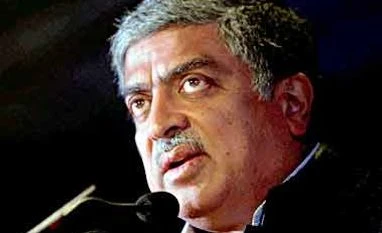 "Nilekani moots models to reboot govt systems")


 Connect with us on WhatsApp