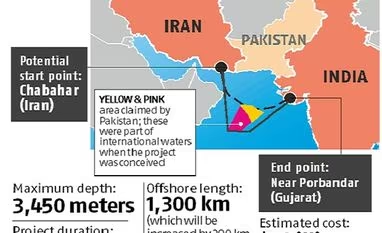
The cost of an under-sea natural gas pipeline, being constructed by Delhi-based South Asia Gas Enterprises (SAGE), between Iran and India will go up by $500-600 million because the company is planning to change its route to avoid crossing Pakistan’s path.
Earlier, the 1,300-km pipeline was expected to cost around $5 billion. However, recently Pakistan claimed an extension of its sea limits from 200 nautical miles to 350 nautical miles (one nautical mile is a little more than 1.8 km), leading to the pipeline being re-routed. This will increase the length of the pipeline by at least 200 km.
“Since Pakistan has claimed that area, which was part of international waters when we planned the project, we will have to re-route this project. However, we need a bit more support from the government in bilateral fora to push the project forward. We are planning to connect this project to the Farzad B block and Oman as well,” said Subodh Kumar Jain, director, SAGE.
In 2015 the United Nations Commission on Limits of Continental Shelf (UNCLCS) accepted Pakistan’s claim for an extension of its continental shelf limits by about 50,000 square km. This will help the country to tap natural resources in that area.
At the UNCLCS, Oman can appeal against this as it comes close to its shores.
According to industry experts, though Pakistan has been pressing for such territorial expansion at international levels since the 2000s, India has been going slow on this.
According to plan, the SAGE pipeline goes from Chabahar in Iran to Porbandar in Gujarat. The company says the cost estimate gives it a gas transport tariff of $2.25-2.5 per million metric British thermal unit, making the landed price much less than the current LNG import prices.
Jain said the project was safer than the Iran-Pakistan-India (IPI) and the Turkmenistan-Afghanistan-Pakistan-India (TAPI) pipelines.
A petroleum ministry official said the government was not in formal talks with the company. He said the proposed pipeline was planned to go 3.8 km below the sea level and hence was the deepest in the world with its accompanying technological challenges.
“The pipeline has been on the drawing board for a few years. However, it is a technically complex project because of the depth of the sea in the region,” said Debasish Mishra, partner at Deloitte Touche Tohmatsu India. The maximum depth of the pipeline is expected to be 3,450 metres, for which the company said it had completed a technical viability study in 2013.
The pipeline is expected to bring in 31 million cubic metres of gas per day to India. This project is considered vital for India as the ministry of petroleum and natural gas estimates the natural gas demand in India to increase at 6.5 per cent per annum to 491 mmscmd (million standard cubic metres a day) by 2020-21.
Jain said the company had signed supply-and-taker agreements with Indian Oil Corporation, Gas Authority of Indian Ltd, Gujarat State Petroleum Corporation, the Oman ministry of oil and gas, and National Iranian Gas Company.
“With some government support, we will be able to complete the project in five years,” Jain said.

 "Pakistan's claim on sea waters to inflate cost of Iran gas pipeline")












