Cornered by the Opposition to make a statement in the House on the state of economy, Prime Minister Manmohan Singh on Friday put his best foot forward to lift investor confidence and bring back weekend cheer.
Displaying that rare combination of an economist and a politician, the prime minister (PM) assured the world — closely watching the rupee movement and the dismal macroeconomic indicators, referring to the situation as a 1991-like crisis — that the India story was intact.
His statement marked the end of a week that saw two socially relevant Bills — on food security and land acquisition — being cleared in the Lok Sabha, both seen as symbols of worry for an already jittery industry. The PM packaged his message with the good news from the export sector, expected to ensure good growth during the rest of the financial year. July exports data had showed a 21-month high of 11.6 per cent.
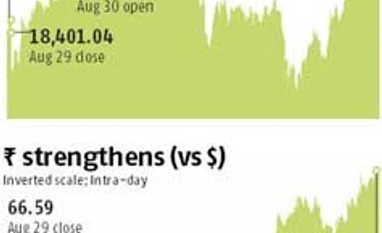
The results were visible by the end of the day: The Sensex gained 218.68 points to close at 18,619.72, the highest level in more than two weeks. The rupee also recovered to 65.71 against the dollar, strengthening 1.32 per cent. The currency had strengthened on Thursday, too.
Admitting short-term shocks would be around for a while, the PM, not known for pep talk, stressed the fundamentals of the economy remained strong. In a tone almost reminiscent of US President Barack Obama’s “we can” speech, Singh said in the Lok Sabha, “We have the capacity to deal with them (the current challenges)”. Economic recovery would start in the second half of the financial year, he said, though that’s a quarter later than what Finance Minister P Chidambaram expected.
On the falling rupee, Singh put the blame squarely on talks of tapering of US quantitative easing, tensions over Syria and the high current account deficit (CAD), which touched a record 4.8 per cent of GDP in 2012-13.
Ruling out capital controls to shore up the rupee value, the PM clarified that the reform process would continue.
He had some comments aimed at industry, too, which had criticised the government for the vote-pulling food security and land Bills.
The PM said he has sought political support for carrying out “more difficult reforms” on insurance, pension, cutting subsidies and the Goods and Services Tax (GST), among others. But, industry, waiting for the 2014 poll results before taking pro-active steps, argued the government should continue to walk the reform path.
“It will be imperative to continue the push on the reform front. We need to reignite the sentiment among investors,” Naina Lal Kidwai, president of the Federation of Indian Chambers of Commerce and Industry, said.
Singh said: “The movement of the exchange rate of the rupee recently is a matter of concern to the government. The rupee has depreciated sharply against the dollar since the last week of May.” There are concerns this could impact the economy, he said. “What triggered the sharp and sudden depreciation was the markets’ reaction to certain unexpected external developments. On May 22, the US central bank indicated it would soon taper its quantitative easing as the US economy was recovering.”
“The easy reforms of the past have been done. We have the more difficult reforms to do, such as reduction of subsidies, insurance and pension sector reforms, eliminating bureaucratic red tape and implementing the Goods and Services Tax. These are not low-hanging fruit and need active political consensus.” Parliament has passed Company’s Bill, and the Lok Sabha had on Thursday passed the land acqusition Bill.
“Growth has slowed in recent quarters. I expect growth in the first quarter of 2013-14 to be relatively flat,” he said hours before official data showed April-June growth at over a four-year low.
He exuded confidence that as the effects of the good monsoon kick in, growth will pick up. Some of the recent steps taken by the government — such as reviving stalled projects, foreign direct investment (FDI) policy relaxation, tax resolution for industry and fuel subsidy reform — will yield positive results, Singh added.
The PM also underscored the fact that currencies of all major emerging economies are on a slide, referring to the Turkish Lira, Brazilian Real, Indonesian Rupiah and the South African Rand.
Singh urged consumers to avoid buying gold. Import of gold has been considered as one of the main contributory factors towards a widening current account deficit.
PM said the only glimmer of hope during such a gloom was the export sector. “Exports are also starting to look up as the rest of the world is improving its growth. So I believe growth will pick up in the second half of the fiscal year, barring extreme unforeseen eventualities.”
Merchandise exports from India jumped 11.64 per cent in July over the last year. The government expects exports to surpass $350 billion this year.

 "PM stresses India growth story intact")

