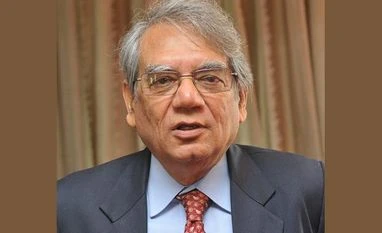
Rakesh Mohan, former deputy governor of the Reserve Bank of India (RBI) and vice-chairman of the Bimal Jalan committee that examined the central bank’s economic capital framework, tells Somesh Jha in a telephonic interview from the US that the earlier framework was a bit too stringent. He talks about the challenges faced by the panel in finalising its recommendations, among other issues. Edited excerpts:
How do you see the implementation of the Bimal Jalan committee’s recommendations by the RBI board?
The RBI board has fully accepted the recommendation that revaluation reserves cannot be distributed, which was a key area of contention last year when discussions were going on. This is commendable. Second, we have suggested a range of 6.5-5.5 per cent of the balance sheet as a prudent contingency risk buffer for containing monetary and financial stability. However, both from the point of view of the RBI and the government, I feel it would have been more prudent to not go down to the lower bound. This year’s surplus was higher than usual and therefore, a large transfer in any case was going to happen. By going down to the lower bound, there is no cushion for the next year in terms of the lower bound. To maintain it at 5.5 per cent of the balance sheet, if the balance sheet expands to 10 per cent, as it has over the past 10 years, on average, it will mean the contingency reserve buffer has to also go up by 10 per cent in absolute terms next year. That would mean that a portion of surplus next year will have to be retained to add to the contingency reserve buffer to keep it at even the lower bound. This could mean retaining around Rs 20,000 crore from the surplus next year.
So you mean the RBI’s surplus distribution will go down next year?
It depends on the magnitude of the surplus. Given the surplus was much larger than usual this year, the likelihood of having a similar surplus wouldn’t be high. They will not be able to transfer the full surplus, as part of it has to go to the contingency risk buffer.
Why did the committee suggest a range and not specify a single figure for various risk provisioning to be done by the RBI?
It would have been a mistake to give one rigid number. If you look at the objectives of inflation targeting by the monetary policy committee, it is 4 per cent plus minus 2 per cent. This is an important aspect of policy making. It would have been a major error on the part of committee to not give a range. After that, it’s up to the decision-makers to look at all the different circumstances to decide where the range has to fall.
Was the economic capital framework that was being followed by the RBI too conservative?
That’s a matter of judgement. We, obviously, have somewhat different judgement in terms of the risk parameters to be used and, of course, we stand by our judgement. In general, I would say if a central bank has to err on any side, I would prefer it errs on the conservative side and not the other side. It could perhaps be argued that the earlier framework was a bit too stringent.
The committee report has advised against utilising the revaluation reserves. But there is a view that it can be used to recapitalise public sector banks. Your views.
That’s been explained very well in the report. Revaluation reserves arrive from the revaluation of foreign exchange reserves and are an accounting entity. If the rupee depreciates, then there has to be a corresponding entry in the balance sheet on the liabilities side. It’s a standard accounting practice. Revaluation accounts are never distributed in a company also. In this case, given the fact that in the last 10 years, the foreign reserves of the RBI have wandered between 60 and 90 per cent of the balance sheet, and which are currently around 70 per cent, revaluation reserves arising from nominal depreciation of the rupee are correspondingly significant. On the other hand, if the rupee appreciates in nominal terms, as has happened in the past in some episodes, as documented in the report, revaluation reserves come down. It, therefore, takes care of market risk effectively. Thus there is no way in which they can be distributed. If you do that at all, you would also have to sell foreign exchange reserves at the same time.
According to a paper by Abhishek Anand, Josh Felman, Navneeraj Sharma, Arvind Subramanian, the RBI had excess reserves to the tune of Rs 5 trillion in 2018-19, as per their own estimates. The committee, though, hasn’t arrived at an exact sum. What do you think the RBI's 'excess reserves' look like?
You need to look at principles. The principles were that revaluation reserves cannot be distributed and the number then falls immediately. We have given a range on the buffers. That paper was completely mistaken and nowhere in the world, is that kind of approach is being followed.
A similar argument was made by the government last year when it estimated ‘excess’ surplus of the RBI to be at Rs 3 trillion…
It was clearly an erroneous approach, which looked neither at the size and composition of the assets side, the need to have balancing liabilities, nor at the character and composition of the liabilities side of the RBI's balance sheet, while giving no recognition to the policy mandate of the Reserve Bank. I hope that the Jalan committee report has put all these issues in the correct perspective, and provided appropriate guidelines and principles for maintenance of the RBI's balance sheet in the interest of the country.
What were the challenges you faced while arriving at a set of recommendations in about seven months?
The first challenge was the context in which the Jalan committee was appointed, starting with the Economic Survey of 2016-17. It argued that excess reserves in the RBI (Reserve Bank of India) were Rs 4.5-7 trillion, which was a very large number. It was a very sensitive situation given the kind of pressure that was put on the RBI last year on this issue. This was presumably among the reasons that led to (former RBI governor) Urjit Patel’s resignation. Therefore, the challenge before the committee was to be able to provide a report, and analytical work therein, which would be politically unmotivated and would essentially be an impartial technical report. Our challenging job was to examine the balance sheet of the RBI on its merits and then arrive at the committee's considered recommendations.
One of the key issues that was considered was that the balance sheet has two sides. If you reduce the magnitude significantly on either side, the other side has to also go down. If you decide that reserves on the liability side are very high and which need to be reduced and disbursed accordingly to the owner of the institution i.e. the government, then the other side of the balance sheet i.e. assets would have to be reduced.
Before doing that, it needs to be understood that the balance sheet of any central bank is a consequence of its policy mandate. It doesn’t exist in isolation. If the mandate includes the maintenance of external and financial stability, it implies the need to maintain some level of foreign exchange reserves, which have to have some relation with the kind of external liabilities of the country as a whole. Therefore, a country like ours need to maintain a certain degree of foreign exchange reserves. At present, for example, the total external liabilities of the country amount to about $1 trillion, of which total external debt is about $500 billion, while the country's total foreign assets are around $600 billion, including about $420 billion forex reserves. Second, one of the key mandates of a central bank is to conduct monetary policy and for that it needs some stock of domestic securities to do market operations. And the third is to maintain financial stability, which includes its functions as the lender of last resort, and market maker of last resort. It, therefore, needs a stock of domestic and international securities to be able to function as an institution in charge of financial stability.
These are all challenges for understanding what determines the central bank’s balance sheet, particularly in context of India. Then one needs to looks at the liability side. In case of all central banks, the main part of the liability side is the monetary liability i.e. currency and bank deposits and the rest of it is economic capital, which constitutes the monetary base of the country's monetary system. The Indian monetary base constitutes about 70 per cent of the balance sheet.
The committee’s mandate was to submit its report in three months. What took it seven months?
There was a lot of technical work that had to be done and careful consideration of issues that had to be addressed. All of that takes time. We also endeavoured to examine all different views carefully so that we didn't ignore any views or miss any issues
There was news of flash points within panel members, especially with the government’s representative. What were the issues?
The final report is a totally unanimous one and the government representative -- the current finance secretary -- has signed it. The RBI board, which includes two government representatives, have accepted the report in toto. We were able to arrive at a report with a view that was analytically sound and was accepted happily by both the RBI and the government. As I understand it, the finance minister has also appreciated the content and conclusions of the report. In principle, there should be no difference in the objectives of the sovereign, i.e. the government, and the central bank, even differences do arise every now and then. It is in the interest of the country for the central bank to maintain external and financial stability, and to conduct a prudent monetary policy. The MPC (monetary policy committee) has a clear mandate to maintain an inflation target of 4 per cent (+- 2 per cent) and to maintain adequate liquidity management.
While the committee took seven months to deliberate upon the RBI’s ECF, it took only one meeting of the RBI’s central board to approve it. How do you see this?
I am not privy to the discussions of the RBI board. But the deputy governor of the RBI and the finance secretary were a member of the committee and the draft report was available to both the government and the RBI, while the work was being done. They knew what was being done. I am not privy to what happened in the central board meeting, but I assume all key aspects of the report were explained. Looking at the press release issued by the RBI, I presume that they covered all the main points.