Safe-harbour margins to be cut

Weak response to transfer pricing rules set out in 2013
current margins
current margins
Dilasha Seth New Delhi
Last Updated : Apr 11 2017 | 1:56 AM IST
The government is set to slash safe-harbour margins in transfer pricing within a few weeks. 

The margins are used to determine the prices of goods and services rendered by multinationals to their subsidiaries in India.

With margins running up to 30 per cent, the government wants to align them with market rates, which could be well under 20 per cent. Margins decided in tribunals or in advance pricing agreements turn out to be much lower, ranging between 15 per cent and 18 per cent. The safe-harbour rules have evoked a tepid response since these were introduced three-and-a-half years ago. 

The move is aimed at simplifying the tax regime and reducing litigation. It will particularly benefit information technology and research companies.

“We are reviewing safe-harbour margins. We will make them more attractive for companies. We may bring them down to under 20 per cent in some cases,” an official said.  

The Central Board of Direct Taxes would issue a notification in this regard over the next 15-20 days, the official added. So far only 30 companies have used the safe-harbour route in transfer pricing.

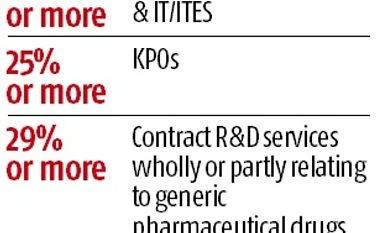
“Rationalisation of safe-harbour margins in light of recent experience in mutual agreement procedures and advance pricing agreements is due. Reasonably aligned safe-harbour margins will ease the pressure on advance pricing agreements,” said Rahul Garg, leader, direct tax, PwC India. Infotech companies with transactions of up to ~500 crore now have a safe-harbour operating margin of 20 per cent and those with transactions above ~500 crore have a safe-harbour margin of 22 per cent. 

Knowledge process outsourcing companies have a safe-harbour operating margin of 25 per cent. Contract R&D services, wholly or partly related to software development, have a margin of 30 per cent or more. The revision will be in line with the recommendations of a committee comprising senior revenue department officials.

India announced its safe-harbour rules in 2013, but the high margins of up to 30 per cent on total operational profits have made this route unattractive for companies.

Safe-harbour rules are directives on margins the tax authorities should accept for the transfer price declared by an assessee.

India has the highest incidence of transfer pricing litigation worldwide. The number of cases scrutinised has quadrupled from 1,061 in 2005-06 to 4,290 in 2014-15.

Safe-harbour rules explained

These provide margins accepted by both the company concerned and the tax authorities under the transfer pricing norms. These margins are mark up to the cost on the basis of which the corporation tax is imposed.

One subscription. Two world-class reads.

Already subscribed? Log in

Subscribe to read the full story →
*Subscribe to Business Standard digital and get complimentary access to The New York Times

Smart Quarterly

₹900

3 Months

₹300/Month

SAVE 25%

Smart Essential

₹2,700

1 Year

₹225/Month

SAVE 46%
*Complimentary New York Times access for the 2nd year will be given after 12 months

Super Saver

₹3,900

2 Years

₹162/Month

Subscribe

Renews automatically, cancel anytime

Here’s what’s included in our digital subscription plans

Exclusive premium stories online

  • Over 30 premium stories daily, handpicked by our editors

Complimentary Access to The New York Times

  • News, Games, Cooking, Audio, Wirecutter & The Athletic

Business Standard Epaper

  • Digital replica of our daily newspaper — with options to read, save, and share

Curated Newsletters

  • Insights on markets, finance, politics, tech, and more delivered to your inbox

Market Analysis & Investment Insights

  • In-depth market analysis & insights with access to The Smart Investor

Archives

  • Repository of articles and publications dating back to 1997

Ad-free Reading

  • Uninterrupted reading experience with no advertisements

Seamless Access Across All Devices

  • Access Business Standard across devices — mobile, tablet, or PC, via web or app

Next Story



