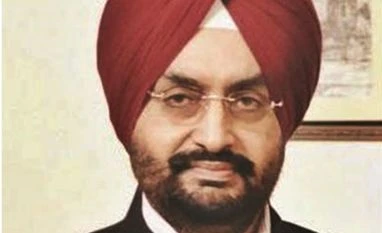
Covid-19's impact on economic activity has been huge this year, but government-led infrastructure building is one area where a revival can be initiated faster. In an interview with Megha Manchanda and Jyoti Mukul, NHAI Chairman Sukhbir Singh Sandhu says that the Authority has been able to award 60 per cent more length in the April-September 2020 period even as the emphasis is on making up for the lost time during the peak summer months. Edited excerpts:
How is the construction of national highways progressing? Is it back to normal from the lockdown days?
Construction is now normal. However, we were badly affected during the lockdown after workers returned to their hometowns and all work came to a standstill. Secondly, April-May are the peak construction months. In these two months, we complete construction work equivalent to four months. The pace of construction during the monsoon goes down and even during winters it is not as good as the summer months. We are catching up and hopefully by March-end we would be able to touch the target.
We took many decisions, which speeded up construction. We were able to award 60 per cent more length of projects during the first half of FY21 as compared to the corresponding period last year. NHAI held camps and provided workers with food and shelter in compliance with safety guidelines so that they could stay and resume work immediately after the lockdown was lifted. For contractors, NHAI disbursed Rs 10,000 crore in March 2020 through online payments so that nothing remained pending due to the closure of offices during the lockdown. In the first quarter of FY21, NHAI disbursed more than Rs 15,000 crore to the vendors.
Additionally, monthly payments were made to contractors to ensure that their cash flow was not disripted. All these measures helped NHAI get back to work almost immediately during Unlock 1 and catch up on the lost time. As of now, we are not thinking of revising the targets. We are to award 4,500 km and build 4,000 km this year.
Is labour still an issue?
It was during the lockdown and a couple of months after that, but since July, the labour issue has been resolved.
What percentage of contractors exercised the force majeure clause of the contract?
Almost all the contractors, particularly the ones running the toll plazas as everyday collections depended on that. They all took advantage of the relaxations. In BOT, we extended the timelines, but wherever the cash compensation is required, things are being worked out.
How much project award has been done so far? What has been the response to HAM after revision in the lending rate?
We have awarded 27 hybrid annuity models (HAM) worth Rs 41,030 crore and 35 EPC projects worth Rs 33,446 crore so far in the current financial year (2020-21). Although the overall number of EPC projects is higher in comparison to HAM, the total value of HAM projects awarded is greater than that of the EPC projects.
How has been NHAI’s fund raising this year? What is the target for the next fiscal?
Our target this fiscal is Rs 65,000 crore and we have a similar target for the next fiscal. We have so far raised Rs 33,500 crore of which Rs 5,000 crore is from State Bank of India as long-term loan, Rs 1,500 crore through 54 EC bonds and Rs 27,000 crore through taxable bonds. As far as the Special Purpose Vehicle for Delhi-Mumbai Expressway is concerned, we may borrow additional Rs 9,000 crore. We already have an offer for Rs 29,000 crore for the SPV.
We have lined up a plan to raise Rs 85,000 crore through monetisation of various publicly-funded highway projects through FY24. The asset monetisation will be carried out through assorted means: infrastructure investment trust (InvIT), toll securitisation and toll-operate-transfer. We are all set to launch our maiden InvIT—the first by a government entity—before March-end and are hoping to have anything around Rs 4,000-5,000 crore.
What is the plan for the next financial year? Are you seeking higher budgetary allocation?
We usually work out the targets in February or March. The budgetary support is usually 10 per cent higher than the previous year. This year it may be more than that as the government wants to spend more on infrastructure. Construction is a long drawn process, first you acquire the land then contract it out and then requisite clearances. It’s a chain of activities to spend the money on. We don’t want to waste the taxpayers' money.
We are seeking to build harmony between the budget allocation and asset monetisation. The idea is to welcome more private investment and boost the economy through highway construction.
What would be the likely break up of projects in terms of mode of construction for the next year?
Our board had earlier approved 60 per cent on HAM, 30 per cent on EPC and 10 per cent on build-operate-transfer (BOT) mode. But because of poor response to BOT, we were unable to reach even 10 per cent. Now with the new norms, we intend to reach that number. Taking a decision administratively, however, is one thing. Eventually, it will be decided by the market. In the last financial year, EPC was more than HAM in the overall construction mix. This year HAM has taken over EPC in terms of increase in construction. There are different categories of contractors for EPC and different for HAM. Only some of them are doing both kinds of projects.
The new model concession agreement (MCA) for BOT has been modified with more attractive terms for concessionaires. It is the model which the contractors look up to. With the revised MCA if the plan materialises for this model, it will mark the revival of pure-
play investors in the highway sector under the public-private partnership framework.
Do competitive bids for EPC mean that the companies want to stick to this mode and not take financial risk?
The companies also require financial muscle for financial closure. In HAM, you need a loan and a good balance sheet to get that loan. In EPC, you don’t require much loan because you construct the road and require monthly payment from the government. Most of the new players are coming under EPC and once they establish a good balance sheet they move to HAM.