Sept core sector growth drops to 4.4% YoY as rains affect infra activity

Core sector rose 16.6 per cent in the first half of the current financial year against a contraction of 14.5 per cent in the corresponding period of the previous year
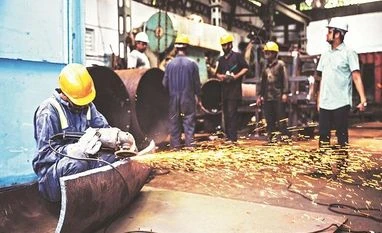
IIP, India's Industrial Production
Any slowdown in the second quarter growth in IIP would affect industrial GDP for the period
Indivjal Dhasmana New Delhi
4 min read Last Updated : Oct 30 2021 | 1:30 AM IST
Growth of eight core industries dropped to 4.4 per cent in September from 11.5 per cent in the previous month due to flat fertilizer production, decline in crude oil output and slowdown in expansion of electricity generation.

This could drag down industrial output growth for the month, despite build up of pre-festival stocks. The core sector has 40 per cent weight in the Index of Industrial Production (IIP).

In fact, the core sector contracted sequentially by five per cent in September over August. While the growth in August had come on the low base of 6.9 per cent contraction in the same month of the previous year, the base in September was also not as high since the sector rose by just 0.6 per cent in the sixth month of FY21.

Madan Sabnavis, chief economist, CARE Ratings, said heavy rains in September hit infrastructure activities — particularly construction — which pulled down growth.

Aditi Nayar, chief economist at ICRA, said, “Lower core sector growth and the impact of semiconductor shortages on auto output are expected to dampen the September IIP growth to 3-5 per cent, despite the pre-festive season inventory build-up, as suggested by the GST e-way bill data.”

E-way bills generation, which has to be done if one moves goods of at least Rs 50,000 by road, rose to 679.4 million in September from 658.93 million in August. IIP has been growing by at least double digits since March, 2021. It rose 133.5 per cent in April due to a low base.

Sunil Kumar Sinha, principal economist at India Ratings, said, “Clearly, the path to a meaningful industrial growth recovery is still hazy.”

However, the eight-industry sector was up by 4.9 per cent in September over pre-Covid level of September, FY20.

Core sector rose 16.6 per cent in the first half of the current financial year against a contraction of 14.5 per cent in the corresponding period of the previous year. However, its growth nosedived to 8.6 per cent in the second quarter of the current financial year against 82.1 per cent in the first quarter. Some slowdown in growth was expected since the base effect of the first quarter was quite low.

Any slowdown in the second quarter growth in IIP would affect industrial GDP for the period. However, industrial GDP is a value number, whereas IIP is a volume figure.

Fertiliser output grew just 0.02 per cent in September against a fall of 3.1 per cent in August. DAP and other complex fertilizers output went down as companies cut down on their imports of raw materials because of sharp increase in international rates which made imports unviable even after subsidy support.

Crude oil production continued to fall even as the rate of decline fell to 1.7 per cent in September against 2.3 per cent in August. In fact, crude production has been falling continuously over a year now. Sabnavis said this had to do with decline in investments by companies, particularly ONGC.

Electricity generation rose by just 0.3 per cent in September against 16 per cent in the previous month. Sabnavis said it was due to lack of demand from commercial consumers, particularly the services sector which has still not been opened fully.

Even as coal production growth also came down to 8.1 per cent in September against 20.6 per cent in the previous month, experts said coal production has been quite high in the past few months — 9.5 per cent in April, seven per cent in May, 7.4 per cent in June and 18.8 per cent in July — which showed that coal shortage issues were more related to inventory management rather than fall in production.

Though cement production growth was down to 10.8 per cent in September from 36.3 per cent in August, it has been maintaining significant expansion since April. This was due to infrastructure spending by the government particularly on roads and railways, said Sabnavis.

One subscription. Two world-class reads.

Already subscribed? Log in

Subscribe to read the full story →
*Subscribe to Business Standard digital and get complimentary access to The New York Times

Smart Quarterly

₹900

3 Months

₹300/Month

SAVE 25%

Smart Essential

₹2,700

1 Year

₹225/Month

SAVE 46%
*Complimentary New York Times access for the 2nd year will be given after 12 months

Super Saver

₹3,900

2 Years

₹162/Month

Subscribe

Renews automatically, cancel anytime

Here’s what’s included in our digital subscription plans

Exclusive premium stories online

  • Over 30 premium stories daily, handpicked by our editors

Complimentary Access to The New York Times

  • News, Games, Cooking, Audio, Wirecutter & The Athletic

Business Standard Epaper

  • Digital replica of our daily newspaper — with options to read, save, and share

Curated Newsletters

  • Insights on markets, finance, politics, tech, and more delivered to your inbox

Market Analysis & Investment Insights

  • In-depth market analysis & insights with access to The Smart Investor

Archives

  • Repository of articles and publications dating back to 1997

Ad-free Reading

  • Uninterrupted reading experience with no advertisements

Seamless Access Across All Devices

  • Access Business Standard across devices — mobile, tablet, or PC, via web or app

Topics :industrial outputIIPCrude OilinfrastructureCore SectorIndian Economy

Next Story



