Some of the worst-governed states have shown it's possible to make the PDS work: Jean Dreze
Interview with Economist and former member of National Advisory Council
Mayank Mishra Reduction in leakages in the Public Distribution System (PDS) is driven by marked improvement in states such as Chhattisgarh, Odisha and Bihar, noted economist and former member of the National Advisory Council
Jean Dreze has said in a recent report. In an email interview to Mayank Mishra, he said the National Food Security Act should bring the bulk of the population under a single category with clear entitlements. Edited excerpts:
PDS leakages are high in developed and seemingly better governed states? Why is it so? I don't think this is a general pattern, though there are certainly examples of relatively developed states with high PDS leakages. What really matters is not the level of development, but the commitment of the state government to PDS reforms as well as public awareness of PDS entitlements. Some of the worst-governed states - for instance, Odisha - have shown that it is possible to make the PDS work. Others such as Uttar Pradesh are yet to show a serious commitment to PDS reform.
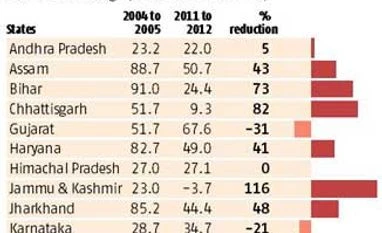
Instead of celebrating reduction in PDS leakage, why are we inflating the number? Your paper argues the fall has been sharper... I don't think the recent reductions in PDS leakages are such that we should celebrate. However, they give a reason for hope that the PDS can be reformed. At the all-India level, the reduction is moderate: from 54 per cent in 2004-05 to 42 per cent in 2011-12, according to the National Sample Survey data, and from 49 to 32 per cent according to India Human Development Survey data. This moderate reduction, however, is driven by dramatic improvements in states that have undertaken bold PDS reforms - Chhattisgarh, Odisha, and, more recently, Bihar. There is no reason why similar reforms cannot be extended across the country.
What has worked in the case of Bihar and Odisha? How have they managed such massive reduction in PDS leakages? Action is needed on the demand side as well as on the supply side. On the demand side, the keywords are broad coverage, low issue prices, and clear entitlements. This ensures that the PDS is under strong public pressure to perform, as happened a long time ago in Tamil Nadu and later in Himachal Pradesh, Andhra Pradesh, Chhattisgarh, Odisha and Bihar. On the supply side, some of the key steps are computerisation, door-step delivery, and deprivatisation of fair price shops, aside from extensive provisions for transparency and grievance redressal. Effective use can also be made of technologies such as smart cards and biometrics.
However, I think they need to be introduced with great caution because inappropriate technology can be very disruptive.
Your paper says much of the leakage happens with regard to ration for the above-poverty-line (APL) category. Does it make sense to do away with this category? Will this reduce the coverage of National Food Security scheme?
The fact that PDS leakages are heavily concentrated in the APL quota is now well established. The main reason is that the APL quota has been used as a dumping ground for excess food stocks, without any attention to transparency. The implementation of the National Food Security Act is an opportunity to phase out this quota and bring the bulk of the population under a single category with clear entitlements.
You recently said that rural employment guarantee scheme would need some reforms. What changes do you recommend?
I believe the scheme needs to be simplified and decentralised. Ideally, it should be largely implemented at the Gram Panchayat level, as is already happening in some states. Frontline functionaries such as Gram Rozgar Sevaks and Block Programme Officers should receive bonus payments linked to the quantity of work generated in their area, to revive their motivation. And of course, accountability provisions such as the unemployment allowance, compensation for delayed payments and the penalty clause should be activated.

 "Some of the worst-governed states have shown it's possible to make the PDS work: Jean Dreze")

