Wholesale prices drop for 12th straight month in October
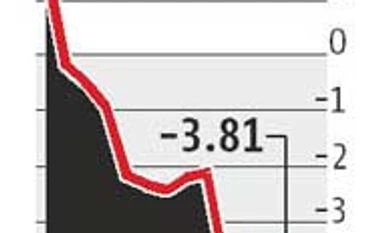
Wholesale price falls by 3.81% even as exports downtrend continues
BS Reporter New Delhi General wholesale prices fell in October for 12th month in a row by 3.81 per cent, official data released on Monday show. It was back in 1975-76 that there was Wholesale Price Index (WPI)-based deflation for a full year. It was in October 2014 that inflation was last seen, at 1.66 per cent.
However, there are a few price pressure points, particularly in food articles. Pulses in particular — these saw inflation rise to almost 53 per cent in October from 38.56 per cent the previous month. Inflation in onions also remained elevated, though it moderated to 85.66 per cent from 113.70 per cent.
“It appears that imports (of pulses) have not been able to quell the prices. Separately, insufficient rain during the monsoon seems to be having a limited effect on vegetables, as overall inflation remains muted at 2.56 per cent but inflation in onion prices has remained high and stands at 85.7 per cent,” said Richa Gupta, senior director, Deloitte in India.
Food inflation rose to 2.44 per cent in October from 0.69 per cent the previous month. In non-food items, oilseeds also showed a rising tendency, to 6.52 per cent in October from 2.21 per cent the previous month.
In other broad categories, deflation decelerated to 16.31 per cent in October from 17.71 per cent in September.
In manufactured products, the rate of price fall declined to 1.67 per cent from 1.73 per cent earlier .
Aditi Nayar, senior economist at ICRA, said: "The pace of contraction of the WPI eased considerably in October, with only minerals and non-food manufactured products recording a deeper disinflation compared to September."
It represents a softening of international prices. However, part of this might be due to slow demand in domestic markets, which might come in the way of revival of economic growth. The government is eyeing second quarter GDP data that will come this month-end to gauge if an economic turnaround is happening. The economy expanded seven per cent in the first quarter of the current financial year, against 7.5 per cent in the previous one.
Food prices, particularly of pulses, had pushed up consumer Price Index-based (CPI) inflation for October to five per cent, the highest in four months, compared with 4.41 per cent in September. Pulses rose 42.2 per cent, year on year, for October. Food inflation has around 45 per cent weight in the CPI, compared to 14 per cent in the WPI.
Nowadays, it is CPI inflation that RBI is setting its eyes on for fixing the policy rate. Nayar said,"Today's data print is unlikely to have a material impact on RBI's coming monetary review, with the central bank expected to hold rates unchanged in its December review." RBI Governor Raghuram Rajan has said the central bank is expected to meet its six per cent retail inflation target for January 2016 and will focus on a five per cent target for March 2017.

 "Wholesale prices drop for 12th straight month in October")


 Connect with us on WhatsApp