Wholesale prices drop for 13th straight month in November
Deflation in manufacturing continues; food inflation jumps
BS Reporter New Delhi Wholesale Price Index (WPI)-based inflation fell for a 13th straight month in November, dropping 1.9 per cent compared to 3.8 per cent in October.
In 1975-76, there was WPI-based deflation for a full year; it was in October 2014 that inflation was last seen, at 1.66 per cent.
Government data released on Monday showed the total build-up in the inflation for the current financial year leading up to November was 0.85 per cent, compared to a build-up rate of 0.50 per cent in the year-ago period.
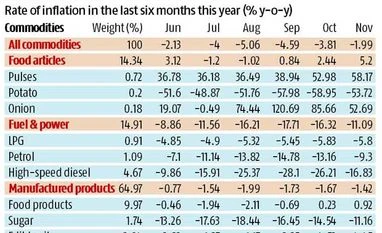
The price pressure points remained, particularly in food articles. The year-on-year rise in pulses in November was 58 per cent compared to 53 per cent in October. The price of pulses has spiked 58 per cent since November last year. “Pulses production has remained a structural issue, which the government should look into,” said D K Joshi, chief economist at CRISIL. He said other than two consecutive monsoons with a poor show, the continuous rise in pulses prices showed a classic demand-supply mismatch.
Inflation in onions also remained elevated, though it moderated to 53 per cent from 85 per cent last month. These two constituted the highest rise in inflation among all commodities.
Overall, food inflation accelerated to 5.2 per cent in November from the 2.44 per cent rise seen in the previous month. Total food inflation rise in the current financial year is 8.7 per cent, close to nine per cent seen in the corresponding period last year.
Food prices rose on account of factors such as supply disruptions after heavy rains in the south and seasonal trends such as a pick-up in demand for non-vegetarian protein items in the winter month. Potato prices continued to beat the trend, falling 53.72 per cent in November. Potato has been the highest falling commodity since last November with its price dropping 53.6 per cent.
Among non-food items, oilseeds rose 6.92 per cent in November. Manufactured products, which have a combined weightage of 65 per cent in the WPI index, continued to show deflationary trends. Year-on-year, the rate of price fall eased to 1.42 per cent in November from 1.67 per cent in the previous month.
The trends represent a softening of international prices. However, part of this might be due to slow demand in domestic markets, which might come in the way of revival of economic growth. The manufactured food products’ sub category, however, showed a slight increase at 0.92 per cent over the past month. This was mainly due to edible oils rising by 4.45 per cent. Sugar prices, on the other hand, dropped 11 per cent.
Another area where prices remained depressed was fuel and power, (15 per cent weightage), which fell 11 per cent compared to last month. All the sectoral components such as liquefied natural gas, petrol and high speed diesel showed a reduction in prices, following global cues. Diesel fell 16.8 per cent in November.
In the immediate term, the imminent rate hike by the US Federal Reserve as well as concerns related to the global growth outlook might continue to exert pressure on commodity prices.
Aditi Nayar, chief economist at ICRA, said, “The impact of continuing commodity price rise may be partly offset by a weakening of the rupee relative to the US dollar.” According to her, further softening of crude oil prices in the ongoing month will lead to core WPI inflation at sub-zero levels in the next two months.

 "Wholesale prices drop for 13th straight month in November")


