Home / Economy / News / Yet another disclosure scheme with 50% tax rate
Yet another disclosure scheme with 50% tax rate
Revenue Secy said I-T Dept wouldn't ask for source of funds deposited in banks from Nov 10, if entire income is declared and 50% taxes are paid
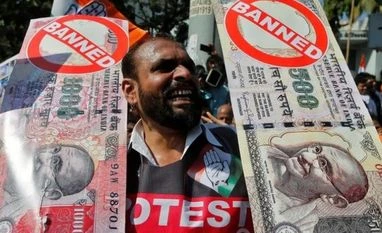
A man holds placards and shouts slogans during a rally organized by India's main opposition Congress party against the government's decision to withdraw 500 and 1000 Indian rupee banknotes from circulation (Photo: Reuters)
The government on Monday unveiled yet another disclosure scheme for deposits made till December 30 and proposed amendments in the Income-Tax Act, proposing harsher penalty for evaders.
Finance Minister Arun Jaitley introduced a Bill to this effect in Parliament on Monday. This is the third income disclosure scheme introduced by the Bharatiya Janata Party (BJP) government in the past two years.
The latest disclosure scheme - Pradhan Mantri Garib Kalyan Yojana - will allow those depositing money in banned Rs 500 and Rs 1,000 notes to enjoy immunity from certain taxation laws by paying a 50% tax on the undisclosed income. However, the declarants will have to deposit a fourth of the undisclosed income with a four-year lock-in.
“The scheme will be notified after the Bill is passed by Parliament. A fourth of the total declared amount will have to be deposited in a bank for four years, which will be used for rural development and poverty alleviation. The Reserve Bank of India is working on it,” said Revenue Secretary Hasmukh Adhia.
The disclosures will enjoy immunity from wealth tax, civil and other taxation laws, but there will be no immunity from foreign exchange violations, narcotics and black money laws.
Adhia added that the tax department would not ask for the source of funds deposited in banks from November 10, if the entire income is declared and 50% taxes paid on it.
The money from the scheme is proposed to be utilised for projects of irrigation, housing, toilets, infrastructure, primary education, primary health, livelihood, etc.
“While it will appear that the black money hoarders will be let off the hook by paying tax at 50% of the declared income, the devil is in the detail. Assuming an interest rate of seven% (offered by State Bank of India) on a fixed deposit for four years, the taxpayer will lose Rs 31 on every Rs 100 deposited under the scheme,” said Rahul Jain partner, Nangia & Co.
The four-month window under the earlier Income Declaration Scheme had closed on September 30. It had allowed declarants to enjoy immunity from a slew of direct taxes by paying a total tax of 45%. The government got declarations from 64,275 individuals worth Rs 65,250 crore from the scheme.
Last year, the government had come out with a similar window for people holding undisclosed assets abroad. Disclosures during that window were charged with a total tax and penalty of 60% and the exchequer received Rs 2,428.4 crore in payments from disclosures worth Rs 4,147 crore.
Under the Bill being presented in Parliament to amend the Income-Tax Act, the government has proposed up to 85% tax if one is caught by the taxman and 75% if one voluntarily discloses unaccounted money against 35% at present.
“The deterrent provisions were necessary so that people have the fear of hoarding black money,” said Adhia. Basically, the unexplained cash or deposits will be levied a flat 60% tax plus a surcharge of 25% of tax. An assessing officer may decide to charge an additional penalty of 10% in addition.
The current provisions of penalty on under-reporting of income at 50% of the tax, and misreporting (200% of tax) will remain unchanged.
Adhia said the search and seizure provisions have been amended to ensure there is fear among people about income-tax raids. Since 10% penalty was to be paid, people used to accept the black money at the time of seizures and returns were filed and taxes paid.
According to Adhia, the government might take more steps against black money after December 2016. “Providing certainty on taxation of deposits in bank accounts post demonetisation is good for voluntary compliance and avoiding litigation,” said Rahul Garg, leader-direct tax, PwC.
Centre tables the Taxation Laws (Second Amendment) Bill, 2016, to amend the Income-Tax Act, 1961, and Finance Act, 2016. According to the proposed changes, if one has Rs 100 as black money, he/she will have to pay to the Centre the following levies
Tax
Cess/ surcharge
Penalty
Others
Those who deposit in old Rs 500 and Rs 1,000 notes, post-demonetisation and declare black money
Rs 30
Rs 10 to go to Pradhan Mantri Garib Kalyan Cess
Rs10
Rs 25 to go to Pradhan Mantri Garib Kalyan Deposit Scheme, 2016, for four years to be used for irrigation, housing, toilets, infra, primary education and health, livelihood. No interest to be paid to depositors
Those who do not declare black money
Rs 60
Rs 15
Rs10, if tax officer decides
Note: There were other amendments to the existing I-T Act as well; Source: Finance Ministry

 "Yet another disclosure scheme with 50% tax rate")


 Connect with us on WhatsApp