Demonetisation: Rs 50,000 as penalty for possessing old notes after Dec 30?

Possession of old notes after December 30 may invite penalty of over Rs 50,000
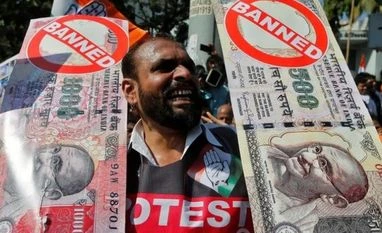
A man holds placards and shouts slogans during a rally organized by India's main opposition Congress party against the government's decision to withdraw 500 and 1000 Indian rupee banknotes from circulation (Photo: Reuters)
BS Web Team New Delhi
Last Updated : Dec 27 2016 | 8:37 AM IST
The government is mulling an ordinance  to bring a new law under which possessing, transferring or receiving  over Rs 10,000 in banned 500 and 1,000-rupee notes post December 30 will be a punishable offence. 

Reports said that there could be a cap of holding no more than 10 notes of each after December 30 and violation of the rule could draw a fine of a minimum of Rs 50,000 or 5 times the amount in question -- whichever is higher, but there was no confirmation. There will be a criminal liability and a municipal magistrate will hear cases involving violation and decide on penalty.

Holders of such currency have an option to deposit them in RBI by March 31 but even that period may be curtailed, they said.O

Of the Rs 15.44 lakh crore worth of 500 and 1000 rupee notes in circulation on November 8, close to Rs 13 lakh crore have been deposited in accounts or exchanged for valid currency.

There was no official word on the move which is likely to come up before the Cabinet on Wednesday.

The ordinance may also extinguish the liability of the government and RBI towards the promise to pay the bearer of these notes their value because of a statutory requirement.

In 1978 a similar ordinance was issued to end the government's liability after Rs 1,000, Rs 5,000 and Rs 10,000 notes were demonetised by the Janata Party government under Morarji Desai.

The government had while announcing the demonetisation of the old currency allowed holders to either exchange them or deposit in bank and post office accounts. While the facility to exchange the old notes has since been withdrawn, depositors have time till Friday to deposit the holding in their accounts.

Under the Garib Kalyan Yojana, people have till March 31, 2017 to disclose their illegal wealth and pay 50 percent tax, while locking in another 25 per cent of the declared income for four years.


*Subscribe to Business Standard digital and get complimentary access to The New York Times

Smart Quarterly

₹900

3 Months

₹300/Month

SAVE 25%

Smart Essential

₹2,700

1 Year

₹225/Month

SAVE 46%
*Complimentary New York Times access for the 2nd year will be given after 12 months

Super Saver

₹3,900

2 Years

₹162/Month

Subscribe

Renews automatically, cancel anytime

Here’s what’s included in our digital subscription plans

Exclusive premium stories online

  • Over 30 premium stories daily, handpicked by our editors

Complimentary Access to The New York Times

  • News, Games, Cooking, Audio, Wirecutter & The Athletic

Business Standard Epaper

  • Digital replica of our daily newspaper — with options to read, save, and share

Curated Newsletters

  • Insights on markets, finance, politics, tech, and more delivered to your inbox

Market Analysis & Investment Insights

  • In-depth market analysis & insights with access to The Smart Investor

Archives

  • Repository of articles and publications dating back to 1997

Ad-free Reading

  • Uninterrupted reading experience with no advertisements

Seamless Access Across All Devices

  • Access Business Standard across devices — mobile, tablet, or PC, via web or app

More From This Section

First Published: Dec 27 2016 | 8:33 AM IST

Next Story