What is the purpose of education? Is it to get a good paying job or to create a good human being? Is it important to teach values and ethics, how to tell right from wrong?
Bijoya Sawian wrestled with these questions before setting up an English-medium school in what was then a rural hamlet, Vikasnagar in Uttarakhand. Right from the word go, Sawian’s focus was on teaching students how to conduct themselves, good manners and behaviour, the difference between right and wrong, the value of cleanliness, integrity, honesty and so on. “Education includes all this — otherwise, we are only making a person literate,” she argues.
Sawian is well-placed to know. A Khasi from Meghalaya, virtually all of her family has been associated with education since the 1800s. Her maternal great-grandfather brought higher school education to the Khasi community in Meghalaya in 1878. Her aunt and mother both ran schools in the state. “It is what we know and do best,” says Sawian.
Her students were primarily first-generation learners. The children’s parents were either too busy making ends meet to teach their children anything or simply lacked an understanding of the kind of values that Sawian focused on. She was clear she wanted her students to go beyond textbooks. “The idea was that students should know how to conduct themselves in society, not just score 90 per cent in examinations,” she adds.
Annfield began in 1997 with three students and grew slowly every year. In the initial years, Sawian managed to schedule a daily period for what she believed was the most important aspect of an education: A full 40 minutes to teach and inculcate values, ethics, morals — concepts virtually alien in India’s education system today.
Once the school got CBSE affiliation, though, the pressure of academic performance began to overtake other priorities. The syllabus was so onerous that students couldn’t afford to spare 40 minutes for value-based education. They almost always have their noses buried in a textbook, with teachers complaining of too little time to cover the vast syllabus. Today the school has 1,200 students from playgroup to Class 12.
Initially, Sawian struggled to find teachers who shared or even understood her philosophy. For instance, some teachers didn’t understand why it was important to throw waste into a dustbin (since a sweeper would do it anyway). With repeated iteration, Sawian feels that many of life’s little lessons have been ingrained not just in the children but a generation or so of teachers who have worked with them over the last 20 years.
Indrani Lahiri, a senior academician who conducts teacher-training workshops across India and at Annfield, says that she thinks the importance of teaching right from wrong cannot be overemphasised. Schools, to her mind, just need to find a way of incorporating this in their primary objectives.
Several years of doling out a CBSE education has convinced Sawian of the need for two critical reforms. One, she says, the curriculum and burden on students needs to be reduced. She says, with a touch of regret, that she’s had to forego her primary focus to an extent because the syllabus is so overwhelming.
Second, there needs to be a liberal arts option for students who don’t want to get into the traditionally valorised disciplines. “Many children are simply not cut out for math and science. Yet they have no option but to pursue it rather vigorously till Class 10,” she says. This often results in a student losing confidence in her own abilities.
A class in moral science or some way of introducing this into the syllabus, according to Sawian, could go a long way in reducing societal afflictions such as violence and crime. She says that parents are too harried and their attention too scattered for young children to learn right from wrong at home. “If the enormity and consequences of crimes like rape is ingrained from a very young age in boys, it may reduce. In a situation where parents are failing to do this job, perhaps the school needs to step in,” she argues.
In addition to introducing “happiness” classes, as the Delhi government has recently done, a dose of moral education could prove invaluable.

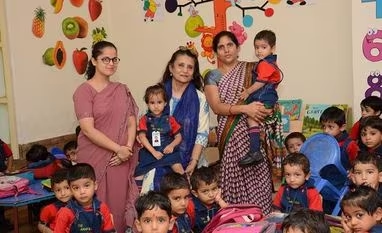 "Uttarakhand's school tries to focus on creating good human beings")












 Connect with us on WhatsApp