“Modi sarkar” is the response of a 12-year-old boy, kicking a football at a deserted marketplace in Lansdowne, a small hill town in Uttarakhand’s Pauri Garwal district, when asked to describe the mask he was wearing. When quizzed further, his partner says: “People distributing posters and banners gave these masks (Narendra Modi masks) to us and asked us to chant ‘Abki baar, Modi sarkar’ once in a while.”
The boys confessed they knew nothing more. Nearly 45 km downhill at a tea stall in Kotdwar, a small town bordering Uttar Pradesh, the topic of discussion (perhaps modelled on Bharatiya Janata Party (BJP)’s prime ministerial candidate Narendra Modi’s Chai Pe Charcha) was “Chappa, chappa, Bhajapa and Abki baar, Modi sarkar.”
For them, Modi sarkar meant return of the Atal Bihari Vajpayee (BJP veteran) regime. “During the Vajpayee regime, sugar was available at Rs 13.5 a kg in open market, we used to get 20 kg of wheat from ration shops and there was no scarcity of kerosene. We hope something like this happens yet again with the change of regime,” says Gopal, one of the most vocal participants in the debate.
His partners in discussion, Maan Singh Thapa and Ramdhan Singh, seemed in total agreement. They concluded the discussion with: “Lekin satta ki chabi Musalmanon ke haath mein hain (The key to a possible regime change lies with the Muslims).”
These are two of the many samples of what people make out of the BJP’s oft-repeated campaign slogan “Abki baar, Modi sarkar” and its PM candidate.
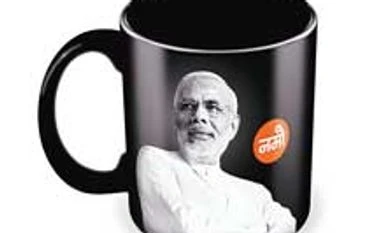
From Gandaman, a small village in Bihar’s Saran district, to Bijnor in Uttar Pradesh; from Satyakhal, a village in Uttarakhand’s Pauri Garwal district, to Bihar Sharif, a small town in Bihar’s Nalanda district, there is no denying Modi is the most talked-about politician and Abki baar, Modi sarkar, the most popular of all slogans.
Based on the feedback from people — in villages, towns and cities — in Bihar, Uttar Pradesh and Uttarakhand, one gets the sense that, to his supporters, Modi stands for decisive leadership, the Gujarat model of development, a dream-like upward mobility sequence (from a chaiwalah to the chief minister of a prosperous state and now a PM candidate), a Hindutva icon and an administrator, who can tame inflation and create unlimited jobs.
“Anyone who has seen Gujarat will not vote for anyone else but Modi,” says an Aam Aadmi Party (AAP) volunteer in Hardwar. He, however, adds the local AAP candidate and former state police chief Kanchan Choudhary Bhattacharya is an exception, “as she, too, is capable of developing the constituency in the same way”. He did not wish to be named.
Does this suggest a “Modi wave” in the Lok Sabha elections? Will BJP ride on this wave and make handsome electoral gains?
Says Sanjay Kumar, a Fellow at the Centre for the Study of Developing Societies: “I will categorise all states into three groups. In one category, where BJP has strong presence (Madhya Pradesh and Rajasthan, for instance), both the party and its PM nominee are pulling voters. In the second category of states (like Bihar and Uttar Pradesh), the Modi factor is likely to result in better performance. And, there are states (West Bengal, Tamil Nadu) where the Modi factor might result in more votes for BJP but it is unlikely to get extra seats there.”
Ground reports also suggest that like different interpretations of the Modi phenomenon, its impact will vary in states. In Uttarkhand, for instance, the rising Modi phenomenon might have indirectly benefited the Congress because of the likely consolidation of Muslim votes. The Congress, facing double anti-incumbency in the state, seems to be strongly placed in two of the five constituencies because of this consolidation, say political observers. Reports also suggest Lalu Prasad’ Rashtriya Janata Dal might have been the likely beneficiary of the Modi phenomenon in Bihar.

 "Making sense of Modi phenomenon")


 Connect with us on WhatsApp