
Modi may show flexiblility but create new problems: China
Chinese daily wrote Modi is expected to present a tougher stance on political disputes
 "Modi may show flexiblility but create new problems: China")
WebinarsNew
Deep DiveNew
Explore Business Standard
Chinese daily wrote Modi is expected to present a tougher stance on political disputes
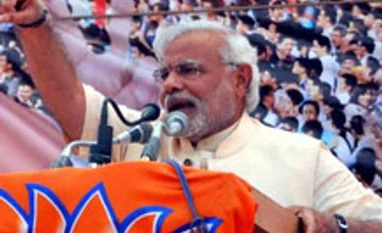
Narendra Modi, widely tipped to be India's next prime minister, may show flexibility in economic ties with China but also "create new problems", a Chinese daily said Wednesday.
"Modi ... is expected to present a tougher stance on political disputes but take a 'more flexible' economic policy towards China," the Global Times quoted analysts as saying.
The article, by Global Times writer Yang Jingjie, was on "India's restrictive policies barrier to trade with China".
The article said Modi, chief minister of Gujarat, "is famed for his pro-business approach and has made four trips to China to woo Chinese investment".
"In a 2011 issue of The Economist, Gujarat was described as 'India's Guangdong', as the state accounted for 5 percent of India's population, 16 percent of its industrial output and 22 percent of its exports."
The article cited Fu Xiaoqiang, a research fellow with the China Institutes of Contemporary International Relations, as saying that "judging from Modi's governance in Gujarat, he places emphasis on infrastructure development, attracting investment and the establishment of special economic zones".
"Economic development and improving people's livelihoods are expected to be high on his agenda once he is elected prime minister," Fu was quoted as saying.
"There is the possibility that he will expand Sino-India economic and trade cooperation and seek more Chinese investment."
According to the Chinese government data, India's trade deficit reached $31.4 billion against China in 2013.
Hu Zhiyong, a research fellow with the Institute of International Relations at the Shanghai Academy of Social Sciences, said this imbalance could not be reversed in the short term.
"Once Modi takes office, he is expected to exhibit some flexibility in economic policy with China but will also create some new problems on bilateral trade frictions."
China's current foreign direct investment in India stands at $940 million.
According to Hu, the shortfall resulted from India's politicisation of economic issues.
"Compared with capital from the US, Japan and South Korea, India has taken a more cautious and restrictive policy toward Chinese investment."
The barriers imposed by Indian authorities had led to a withdrawal of most small and medium-sized Chinese companies from the market in India's tech hub Bangalore, Hu said.
"There are also so-called security concerns over Chinese investment, which has led to denials of major investment by telecom giant Huawei in the country."
At the same time, the article pointed out that Modi had taken a hard line towards China politically.
"The BJP has long held a hardline position towards China. Modi will no doubt inherit the party's stance. He will be tougher against Beijing and use border disputes, the Tibet question and the Dalai Lama to bargain with China," Hu said.
But Fu sounded more optimistic vis-a-vis Sino-Indian relations.
"The two countries have reached a border defence cooperation agreement (in October 2013) and both maintained that the disputes should be solved through negotiations," Fu said, adding that the border disputes could be controlled and would not threaten bilateral cooperation in other areas.
First Published: May 14 2014 | 3:52 PM IST


 Connect with us on WhatsApp