It’s election time and the opinion of women has suddenly begun to matter a lot. Judging by the promises made by political parties in the five poll-bound states, gender is being tapped as a significant differentiator by political parties. Prime Minister Narendra Modi said as much earlier this week. He told party workers they had a “very big task” to reach out to women voters. “The support of sisters like you is my real power,” Modi told a woman on his campaign trail in Varanasi, his Lok Sabha constituency.
The powerful appeal to gender to mark a significant difference was used last by Bihar Chief Minister Nitish Kumar, who announced prohibition in 2016, soon after returning to power the previous year. This followed a number of steps Kumar had taken in his earlier tenure to empower girls and women. Prohibition, despite all its implementation downsides, became a big electoral hit and although Kumar’s party, the Janata Dal (United), or JD(U), reported an electoral strike rate of only 33 per cent in the 2020 Assembly election against its alliance partner, the BJP, ringing up 65 per cent, Kumar’s prohibition decision was hailed by analysts as the game changer that saved his party from complete decimation. The turnout of women was much higher than that of men in 2020, suggesting that women, if addressed properly, have the potential to become a decisive factor in elections.
But never ones to let facts get in the way of a good campaign weapon, political parties have begun lobbying hard to address women. In UP, not only has the Congress promised 40 per cent of all nomination to women and a matching number of government jobs to be reserved for them if the party comes to power, in Goa, it is offering women 30 per cent seat reservation in jobs. Other parties were quick to follow. The Trinamool Congress, a new entrant in the state’s political theatre, announced the launch of the “Griha Laxmi Card” cash assistance scheme, which promises Rs 5,000 per month to each woman in every household in Goa as guaranteed income support. A similar cash allowance was offered by the Aam Aadmi Party (AAP) in the state — but only Rs 1,000 a month.
Psephologist Sanjay Kumar, former director of the Centre for the Study of Developing Societies (CSDS), said: “Political parties are increasingly realising the importance of women voters and this isn’t just specific to Goa. Earlier, women’s turnout in elections used to be low compared to that of men. There is a big change now and women are coming out to vote. With more education and social media penetration, women are taking their own voting decisions. In fact, in states such as Goa, Manipur, Meghalaya, Kerala, and Arunachal Pradesh, the turnout of women is higher than that of men.”
In Punjab, most analysts predict the AAP’s promise of cash allowances to women (Rs 1,000 a month) will prove a big hit. The party has already begun the process of registering women for the scheme, establishing that it means business. With high levels of male migration many households in Punjab are headed by women, but they have no independent access to finances. The AAP’s commitment spells financial autonomy to women.
Promises there are aplenty. But when it comes to giving nominations, it is the Congress that has shown its cards first. In UP, Sadaf Jafar, the actress who was jailed for her role in demonstrations against the citizenship law, is now a Congress spokeswoman and candidate. Poonam Pandey, who led a protest for wages by ASHA workers, is a Congress nominee. The mother of the survivor of the Unnao rape incident has been given nomination as well. On the UP list of 107 candidates declared by the BJP, 10 are women. The Samajwadi Party has fielded one female candidate out of 94 announced so far — who is from its alliance partner, the Rashtriya Lok Dal.

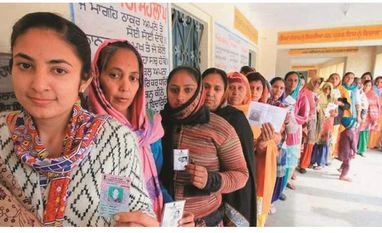 "Elections & 'she' factor: Promises galore as parties put spotlight on women")










 Connect with us on WhatsApp