“News was flashed on many channels that I cannot be seen anywhere. I would like to tell everyone that I came from Delhi to Lucknow as soon as the Covid scare subsided. I have been working constantly to strengthen the party. I reviewed the party’s functioning and party affairs in the entire state. It is the media that has created this fiction that I am absent,” said Mayawati, Bahujan Samaj Party (BSP) chief and former UP Chief Minister Mayawati, during her first public meeting since campaigning for the UP Assembly election began. She was addressing an open-ground meeting at Agra last week. Elections in Noida, Agra, and other parts of western UP are due on February 10.
In her native village Badalpur in Greater Noida, voters are less impressed. On one hand, the village pradhan, Gyan Nagar, says: “She is the daughter of this village. Of course, we support her.” On the other, many around him say a mood for “badlav (a change)” is palpable.
The Samajwadi Party (SP) has never been able to win from this region which returned a BJP MLA in the last election. With the poll round the corner, everyone is a bit cagey about vouchsafing an opinion. Badalpur falls in the Dadri constituency adjoining Noida.
Dalit voters in western UP are in a bind. Their heart is telling them to go with Behanji. But those whom she had supported are all leaving. The BSP’s Meerut Mayor Sunita Verma, her husband Yogesh Verma, an ex-minister and former BSP MLA from Hastinapur, joined the SP a day after Mayawati’s 65th birthday (January 15). So did former BSP MLA from the Bareilly constituency, Vijay Pal Singh. Along with them, former BSP MLA from Thakuardwara (Moradabad) Vijay Yadav and ex-UP minister Awadhesh Verma also joined Akhilesh Yadav’s party. Former BSP MP from Lakhimpur, Dawood Ahmed, too, switched camps. In Badalpur itself, a BSP organiser crossed over to the SP.
“This is her village. We’ve voted for her many times. It is time we gave somebody else a chance,” says a young man whose bulging muscles suggest he is a body-builder. He confesses he has no work. “Our biggest problem is unemployment. There are no jobs. Young people are sitting at home. The BJP may be a good party. But for us, it has changed nothing except that it has built some roads,” says another young man.
Jatavs, the caste to which Mayawati belongs, form over 50 per cent of Scheduled Caste communities in the state, with Dhobi, Pasi, Kori, Valmiki, Khatik and others making up the rest and representing a potent political force. Of the 403 seats in the Assembly, 84 are reserved for SCs. In 2017, the BJP won 70 of those and in 2012, the SP, which won with a majority, won 58 of the 84. When it won a majority in 2007, the BSP had managed 62 SC seats. In 2017, the BSP contested 403 seats but won only 19, though its vote share stood at 22.23 per cent. The BJP tore away the votes but not the support base.
This time, says Dalit ideologue Chandrabhan Prasad, expect the unexpected. Prasad undertook an intensive field study of UP in the first two weeks of January. He says lower OBCs — Gurjars and Lodhs, for instance — are still with the BJP. But many other sections, including Brahmins, have moved away. “The educated Dalit — I like to call it the Dalit middle class — is moving over to the Samajwadi Party. They believe that defeating the BJP is more important than making a Dalit prime minister or chief minister”.
On the ground, this proposition has some resonance. Kriparam Sharma had been hoping the party he’s served for three decades, the Congress, would give him the nomination. It went instead to Pakhuri Pathak, a feisty 29-year old young women activist, and Sharma joined the BSP, which has now fielded him. In the congested bylanes of Nithari village in the heart of the Nodia assembly constituency, an avid discussion is on over “badlav”. Voters concede Pankaj Singh, son of Defence Minister Rajnath Singh who won the election in 2017 as the BJP’s candidate and is contesting again, is a ‘decent person’. But they are non-committal about voting for him. The ire is not aimed at him — it seems to be directed elsewhere.
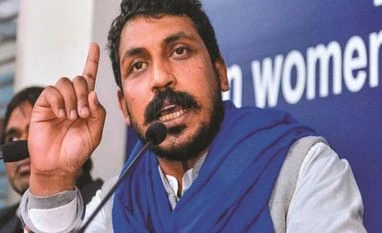
In the overall Dalit political equation, there is a known unknown: Chandrashekhar Azad Raavan, whose Bhim Sena is making waves but the jury is still out on whether it will get votes. Raavan does not represent a pan-UP political organisation. But he has a powerful voice that younger Dalits find especially stirring. This election will decide if he has a hold.
This much is clear: Dalits in Uttar Pradesh are reviewing their options. That in itself is a change.