In the opening scene of The Hustle, a shady guy pulls up along a New York walkway, with “Baller” scrawled across his car’s licence plate, and strolls into a bar. There, instead of encountering the porn queen of his dreams he’s been courting on a dating app, he is greeted by Penny Rust, played by Rebel Wilson. Stunned that Penny is nothing like the voluptuous doll he was expecting, Wilson explains that the woman is her sister, and contrary to what he’s been made to believe so far, she is actually flat-chested. But he can fix that by giving her the $500 she desperately needs for the augmentation surgery. The guy is convinced in a heartbeat and agrees to wire the money to Penny.
If you were to sum up The Hustle in one sequence, this is pretty much it. It’s a highly unimaginative plot that is unbelievable on an absurd number of levels. For one, if remakes already weren’t hard enough, the producers here have almost attempted the impossible: remaking a film which was a remake in the first place. The Hustle is a gender-swapped reboot of Dirty Rotten Scoundrels (1988) that featured Michael Caine and Steve Martin, which itself was inspired by the Marlon Brando- and David Niven-starrer Bedtime Story (1964).
Even if you were to, for a second, disassociate The Hustle from successes past, it explores stale territory that never allows its characters to soar. Anne Hathaway plays Josephine Chesterfield, a suave British con artist with a flair for accents — she does American, German and French with the vocal dexterity of a Christoph Waltz in a Quentin Tarantino film. Soon, the home patch of this seasoned swindler is intruded upon by Wilson, a cloddish fellow con who can match Hathaway in the talent stakes but is bereft of the easy elegance that has turned the latter into a millionaire in the fictional French Riviera town of Beaumont-sur-Mer.
The two collaborate — Penny acting as the deranged younger sister to “Princess” Josephine who walks away with expensive rings gifted to her by her wealthy fiancés — and then fall out, and eventually compete with each other to win the trust — and money — of a tech billionaire, a too-obvious Mark Zuckerberg clone essayed by Alex Sharp.
The annoyed sophisticate working in tandem with the uncouth sidekick is an ancient trope, and could have worked here too, only if there were some genuine laughs on offer. Wilson’s buffoonery throws up some memorable moments, but most of that is drowned out by a shabby script that tries to focus on new gender dynamics but ends up being little more than an extended cliché. Hathaway is too stern, almost too correct throughout, and mostly makes for colossally unfunny viewing. In some ways, Josephine is an extension of her role in Ocean’s 8, but overdone and overexposed. Her character is so poorly written that it seems like a perplexing cross between a European horse owner and a Hollywood real estate agent. By the end, you wonder if she’s British at all.
Wilson, on the other hand, is the obese slob who eats too much, drinks too much and messes up too much. The chemistry between the two leading ladies never quite comes alive, and Chris Addison’s (this is the Welsh comedian’s debut film) direction adds little pace or precision to the plot. The run-up to the climax is haphazard, with random sequences — Penny has a pointless fling with a man twice her age on an airplane, for instance — adding nothing to an already feeble storyline.
What’s more, The Hustle enforces the false notion that the only way women can get strong roles is by stepping into characters once played by men. It’s a shortcut that gives them little power and, in this case, leaves the likes of Hathaway and Wilson powerless to save a middling film.

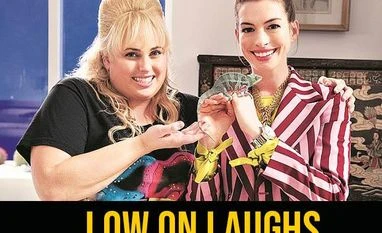 "Movie review: 'The Hustle' fails to show changed gender dynamics comically")











