China adds risks to global growth as factories take a hit on Covid controls

Manufacturing PMI at 48 for Nov against 49.2 a month ago, services sector activity fell to 46.7
china economy, china covid, china lockdown
Photo: Bloomberg
Agencies
4 min read Last Updated : Dec 01 2022 | 12:44 AM IST
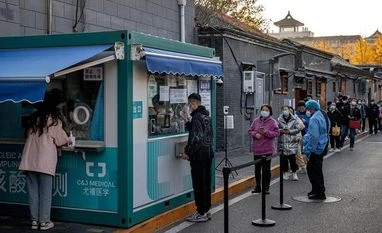
China’s manufacturing and services activities shrank further in November to seven-month lows, official data showed, stung by the country’s strict Covid-19 rcurbs and rising infections that analysts said will hurt the economy well into 2023.
 
Against this backdrop, the official manufacturing purchasing managers’ index (PMI) came in at 48.0 for November against 49.2 in the previous month, the lowest reading in seven months, according to data released by the National Bureau of Statistics (NBS) on Wednesday. 
 
Separately, the non-manufacturing PMI, which looks at services sector activity, fell to 46.7 from 48.7 in October, also the lowest reading in seven months.
 
The 50-point mark separates contraction from growth on a monthly basis.
 
“Downside risks continue to grow as the virus situation continues to worsen and will weigh heavily on the economy into 2023,”  said Sheana Yue, China economist at Capital Economics, in a research note.
 
The sub-indexes for manufacturing PMI including output, employment and suppliers’ delivery times all shrank in November at a faster pace than the month before, the data showed.
 
New orders and new export orders sub-indexes both fell further, largely driven by weakening domestic and foreign demand.
China’s blue-chip stock index CSI300 and the Shanghai Composite Index rose slightly on Wednesday despite the sluggish factory activity, partly driven by government support policies.
 
Chinese authorities this month rolled out a flurry of policies to prop up the economy, including reserve requirement ratio cuts and Covid-19 fine-tuning measures, while loosening financing curbs to rescue the property sector. 
 
The securities regulator  lifted a ban on equity refinancing for listed firms, in the latest support measure for the cash-squeezed real estate sector.

Covid curbs in city with key iPhone plant eased
 
The Chinese city of Zhengzhou shuttered hundreds of buildings and apartment blocks hours after lifting broader lockdown measures, as officials strive to make their Covid controls more targeted in line with Beijing’s directives. 
 
The city, home to Apple’s largest manufacturing site in China, said late Tuesday that it was lifting a lockdown of its main urban areas put in place five days ago as Covid cases climbed. 
 
Authorities then issued a lengthy list of buildings that would be declared high risk spanning the greater Zhengzhou region, which means they will continue to be subject to lockdown-style curbs.
Locked-down South China caught in violent protests
 
Residents in the southern Chinese manufacturing city of Guangzhou clashed with police on Tuesday night, footage posted on social media showed.
 
Dozens of protesters in the city’s Haizhu district were seen throwing objects at cops in hazmat suits. Police fired what appeard to be tear gas at a group of protesters in an alley. 
 
In response Guangzhou became the latest to announce an easing of curbs on Wednesday and lifted lockdowns in most parts of the city, including those hit by rioting, replacing them with targeted restrictions as officials try to rein in excessive curbs.

All but one of city’s 11 districts ended the measures.
Protests seen across globe
 
Protests over Beijing’s strict covid response have spread from China to cities and college campuses around the world to show solidarity with the rare anti-government demonstrations erupting across the country.
 
In Taiwan, people gathered with candles at the vigil, and held up blank sheets of paper and chanted: “China needs freedom,” “Give me liberty or give me death,” “Rest in peace for the dead” and “Continue to fight.”
 
In Britain, more than 100 protesters gathered outside the Chinese Embassy in London late Sunday. 
 
In US, College campuses across the United States are also planning vigils.  In Canada,  a video filmed outside the Chinese Consulate in Toronto and posted to Twitter on Sunday showed Mandarin-speaking demonstrators chanting slogans.
 
In Japan, about 90 people gathered for a vigil in Tokyo on Sunday to commemorate the victims of the Urumqi fire agencies

One subscription. Two world-class reads.

Already subscribed? Log in

Subscribe to read the full story →
*Subscribe to Business Standard digital and get complimentary access to The New York Times

Smart Quarterly

₹900

3 Months

₹300/Month

SAVE 25%

Smart Essential

₹2,700

1 Year

₹225/Month

SAVE 46%
*Complimentary New York Times access for the 2nd year will be given after 12 months

Super Saver

₹3,900

2 Years

₹162/Month

Subscribe

Renews automatically, cancel anytime

Here’s what’s included in our digital subscription plans

Exclusive premium stories online

  • Over 30 premium stories daily, handpicked by our editors

Complimentary Access to The New York Times

  • News, Games, Cooking, Audio, Wirecutter & The Athletic

Business Standard Epaper

  • Digital replica of our daily newspaper — with options to read, save, and share

Curated Newsletters

  • Insights on markets, finance, politics, tech, and more delivered to your inbox

Market Analysis & Investment Insights

  • In-depth market analysis & insights with access to The Smart Investor

Archives

  • Repository of articles and publications dating back to 1997

Ad-free Reading

  • Uninterrupted reading experience with no advertisements

Seamless Access Across All Devices

  • Access Business Standard across devices — mobile, tablet, or PC, via web or app

Topics :CoronavirusChinaGlobal economyFactory outputGlobal growth forecastsChina economic growth

Next Story



