China’s factory activity shrank for the fourth straight month in April, signaling economic weakness into the second quarter, a preliminary survey showed on Wednesday, although the pace of decline eased helped by policy steps to arrest the slowdown.
Analysts see initial signs of stabilisation in the economy due to the government’s targeted measures to underpin growth, but believe more policy support may be needed as structural reforms put additional pressure on activity.
The HSBC/Markit flash Purchasing Managers Index (PMI) for April rose to 48.3 from March’s final reading of 48.0, but was still below the 50 line separating expansion from contraction.
“It’s generally in line (with expectations), reflecting that growth momentum is stabilising,” said Zhou Hao, China economist at ANZ in Shanghai.
Hao expected economic growth to pick up slightly to 7.5 per cent in the second quarter.
Annual growth slowed to 7.4 per cent in the first quarter from a year earlier, its slowest reading in 18 months, but the pace was just ahead of market expectations and seemed to soothe fears of a sharp downturn.
<B>Modest stimulus measures</B><BR>
China’s central bank will cut the amount of deposits rural banks must hold as reserves by between 0.5 and 2 percentage points, it said on Tuesday, the latest in a series of measures to help combat the slowing economy.
CICC estimated that the reserve cut could release 110 billion yuan ($17.64 billion) of bank liquidity, while Nomura put the amount at 80-90 billion yuan, which was small given the size of the economy.
Other economists however expect a cut in the reserve requirement ratio for all banks later this year, as protracted economic weakness fuels capital outflows, raising the pressure on the central bank to pump more liquidity into the economy.
“We do not believe that this uptick in the HSBC PMI signals any sort of turning point for the economy and continue to believe that growth momentum is on a downtrend,” Nomura analysts said in a client note.
“We maintain our view that the PBoC will cut the RRR for the whole banking sector in May or June,” they said, forecasting second-quarter growth to fall to 7.1 per cent.
The government has already unveiled steps to quicken construction of railways and affordable housing for the poor, and to cut taxes for small firms to underpin growth.
Signs of a slowdown in the first quarter had been evident in a series of economic indicators, prompting the government to unveil a series of measures to promote growth, although it has ruled out major stimulus.
It has also said that its main focus will be on job creation, and that it did not matter if growth in 2014 came in a little below the official target of 7.5 per cent.
The country’s top economic planning body reiterated the message on Wednesday, saying that the economy will be fine without any heavy stimulus.
“We are confident that we have all means and are capable of keeping economic growth stable and healthy in the relatively long term, Li Pumin, spokesman of the National Development and Reform Commission (NDRC), told a media briefing.
“We will not take short term strong stimulus in response to momentary economic fluctuations.”
The PMI survey showed contractions in new orders and output moderated somewhat, though employment decreased at a faster rate and new export orders slipped back below the 50 line after a pick-up in March, suggesting that the external environment remains difficult for Chinese firms.
“Domestic demand showed mild improvement and deflationary pressures eased, but downside risks to growth are still evident as both new export orders and employment contracted,” said Qu Hongbin, chief economist for China at HSBC, in a statement accompanying the PMI.
He added that he expected more government support measures in coming months, which was echoed by ANZ’s Zhou, who believed policy support would be targeted and measured.
Analysts believe that China’s property market could be one threat to Beijing’s plan to manage a slowdown in growth, as evidence mounts of a rapid cooling in what had been one of the few strong spots in the world’s second-largest economy.

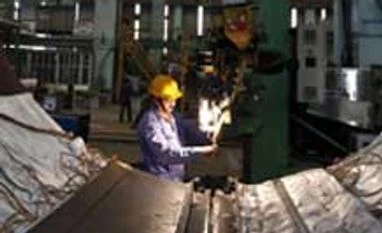 "China factory activity shrinks for fourth month")


 Connect with us on WhatsApp