Home / World News / Donald Trump's new tariffs hardly matter for US automakers in China
Donald Trump's new tariffs hardly matter for US automakers in China
GM's partners in China include SAIC Motor Corp., while Ford has tied up with Changan Automobile Group and holds a stake in Jiangling Motors Corp
premium
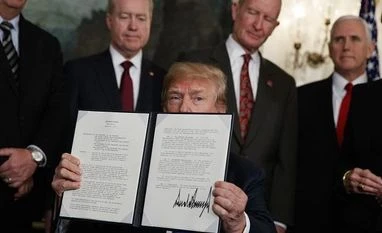
President Donald Trump displays signs a presidential memorandum imposing tariffs and investment restrictions on China in the Diplomatic Reception Room of the White House. Photo: AP | PTI
Auto workers in the US hoping President Donald Trump’s tougher approach to China will help create jobs at home and cut the trade deficit by $100 billion may be in for a huge disappointment.
General Motors Co and Ford Motor Co. are among companies that already make cars in China with domestic partners for the local buyer, not only to avoid the 25 per cent import duty but also to take advantage of lower costs. GM’s partners in China include SAIC Motor Corp., while Ford has tied up with Changan Automobile Group and holds a stake in Jiangling Motors Corp.
Cutting the tariff “will have no measurable impact on the US trade deficit,” said Steve Man, an analyst with Bloomberg Intelligence. “It just doesn’t make sense to ship high volumes of vehicles into China since it’s still cheaper to build them there.”
But for Elon Musk, the levy is a hurdle. The billionaire’s attempts to set up a Tesla Inc. factory in China have stalled over a disagreement on the ownership structure, people with direct knowledge of the situation said last month. While China wants Musk to set up a joint venture with a local maker, the entrepreneur wants full control. Musk, in his tweets, has decried China’s trade practices and said earlier this month that Trump’s moves are quite likely to result in a “fair outcome for all.”
China requires overseas automakers to form joint ventures with local manufacturers in which the foreign companies are capped at 50 percent ownership.
The government’s aim when introducing the policy in the 1990s was for its then-fledgling auto industry to benefit from technology transfer by operating along with global giants including Volkswagen AG and GM.
Ford has six assembly plants in China, while GM has eight factories under its main joint venture, according to the companies’ websites.
China asks US to offset trade losses
China asked the US to provide compensation for lost trade due to President Donald Trump’s proposed tariffs on steel and aluminum, in a preliminary step that could lead to a dispute between the two nations at the World Trade Organization.
In two filings with the WTO on Monday, China dismissed the US assertion that the metal tariffs were instituted on national security grounds, arguing instead that they were safeguard measures — temporary trade restrictions aimed at protecting domestic producers.
China responded to the US action by threatening to impose tariffs on $3 billion of US imports — including agricultural, steel and aluminum products —and its ambassador to the US said all options are on the table, though the Asian nation doesn’t want a trade war.
Read this article for free
Register to continue reading premium journalism and analysis from Business Standard.

 "Donald Trump's new tariffs hardly matter for US automakers in China")











