
French President Emmanuel Macron vows to fight 'Islamist separatism'
His proposals include stricter oversight of schooling and control over foreign funding of mosques
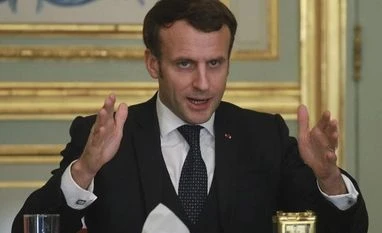 "French President Emmanuel Macron vows to fight 'Islamist separatism'")
WebinarsNew
Deep DiveNew
Explore Business Standard
His proposals include stricter oversight of schooling and control over foreign funding of mosques
French President Emmanuel Macron has announced plans for tougher laws to tackle what he called "Islamist separatism" and defend secular values.
In a keenly awaited speech, Macron said a minority of France's estimated six million Muslims were in danger of forming a "counter-society", the BBC reported on Friday.
His proposals include stricter oversight of schooling and control over foreign funding of mosques.
He had been under pressure to address radical Islam amid security fears.
But his comments were condemned by some Muslim activists who accused him of trying to repress Islam in the country.
Under France's strict principles of secularism, or laicite, the government is separated by law from religious institutions. The idea is that people of different religions and beliefs are equal before the law.
The country also has the largest population of Muslims in Western Europe. Many complain the authorities use secularism to specifically target them, for instance in banning the hijab.
Speaking outside Paris on Friday, Macron said radical Islam was a danger to France because it held its own laws above all others and "often results in the creation of a counter-society".
He said this form of sectarianism often translated into children being kept out of school, and the use of sporting, cultural and other community activities as a "pretext to teach principles that do not conform to the laws of the republic".
"Islam is a religion that is in crisis all over the world today, we are not just seeing this in our country."
The measures announced by the president will form legislation that will go to parliament before the end of the year.
They include -- stricter monitoring of sports organisations and other associations so that they do not become a front for Islamist teaching, an end to the system of imams being sent to France from abroad, improved oversight of the financing of mosques and home-schooling restricted
Macron also said France must do more to offer economic and social mobility to immigrant communities, adding that radicals had often filled the vacuum.
--IANS
int/
(Only the headline and picture of this report may have been reworked by the Business Standard staff; the rest of the content is auto-generated from a syndicated feed.)
First Published: Oct 03 2020 | 6:30 AM IST


 Connect with us on WhatsApp