From good to bad to worse: The possible results of Trump-Kim meet

Take a look at the possible results of the Trump-Kim summit
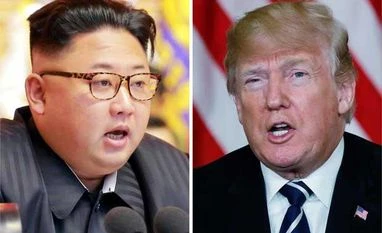
Donald Trump, Kim Jong Un
Donald Trump looks forward to meeting Kim Jong Un Photo: Reuters
Bloomberg
Last Updated : Jun 01 2018 | 2:31 PM IST
The on-again, off-again summit between US President Donald Trump and North Korean leader Kim Jong Un now appears increasingly likely to take place -- but it’s not yet clear what kind of agreement, if any, the two leaders will be able to reach.

North Korea has ruled out the so-called “Libya model” where it loads its nuclear program onto planes bound for the US right away, with Kim saying Thursday the issue should be “solved on a stage-by-stage basis.” Trump insists that the end goal is denuclearization, but has left the door open to a phased approach. We take a look at the possible results.

Kick the Can Down the Road

The most likely outcome may be an agreement to keep talking. Such a deal would involve a lofty declaration that both sides seek peace -- even a formal treaty -- and a commitment to work toward the goal of ridding the Korean peninsula of nuclear weapons.

Under such a deal, North Korea could announce an extended moratorium on nuclear and missile testing in exchange for modest sanctions relief. The US may also want any agreement to explicitly mention shorter-range missiles so as not to jeopardize alliances with Japan and South Korea, both of which are vulnerable to attack.

Kim said late last year he had obtained the ability to strike the US with a nuclear weapon. Since then he’s unilaterally suspended nuclear and missile tests, closed the test site where the country detonated all six of its nuclear devices, and turned his focus to building the economy.

“It is costless for Kim to say I am not going to do nuclear or missiles tests for now because frankly they are a stage in their cycle where they don’t need to,” said Vipin Narang, an associate professor of political science at the Massachusetts Institute of Technology who focuses on nuclear issues.


Denuclearisation

This is the biggest sticking point between the two sides. While it’s probably unrealistic for the Trump and Kim to agree on all aspects of denuclearization at their first meeting, many experts say it’s still possible to go meaningfully beyond a kick-the-can-down-the-road accord.

To do so, they would need to emerge with “a clear sense of what the diplomatic pathway is” for achieving complete and verifiable denuclearization, said Mira Rapp-Hooper, senior research scholar at Yale Law School’s Paul Tsai China Center.

That would include a timetable for detailed negotiations on dismantlement, verification, and implementation phases, according to Douglas Paal, vice president for studies at the Carnegie Endowment for International Peace. North Korea will be angling to hang on to the weapons “as long as possible,” he said.

Lisa Collins, a fellow with the Korea chair at the Center for Strategic and International Studies, said the time horizon could be a decade. Trump “seems to think it could happen within 3 months or 6 months,” she said. “Most nuclear weapons experts I talk to say it will take at least 10 years.”

North Korean Concessions

A good deal for the US would eliminate or cap production of North Korea’s two classes of intercontinental ballistic missiles -- the Hwasong 14 and the larger and more developed Hwasong 15 -- as well as shorter-range missiles that would be used in an attack on Japan or South Korea.

North Korea could also agree to limit the size of its stockpile of fissile material used for making nuclear weapons. Such a move would need to be accompanied by credible verification measures and assurances that North Korea’s Yongbyon nuclear plant had ceased production. The facility also could be slated for eventual dismantlement.


Experts say verification is the key to any lasting deal. An accord with North Korea will hinge on the degree to which Kim would allow inspectors -- such as the International Atomic Energy Agency -- access to its facilities to verify commitments.

US Concessions

Trump could offer Kim a number of immediate and tangible incentives to start getting rid of his nuclear weapons. Chief among them is relief from the tightest economic sanctions the US has imposed on North Korea in decades.

Trump could also reduce the number of US troops in South Korea from the 28,500 currently deployed toward 22,000, the minimum allowed under an amendment to the National Defense Authorization Act passed by Congress and confirmed on May 14. This is something Trump talked about in his election campaign.

In a more modest step, the US could agree to limit the size and scope of its military exercises. North Korea would likely be expected to curtail its military drills in return.

One subscription. Two world-class reads.

Already subscribed? Log in

Subscribe to read the full story →
*Subscribe to Business Standard digital and get complimentary access to The New York Times

Smart Quarterly

₹900

3 Months

₹300/Month

SAVE 25%

Smart Essential

₹2,700

1 Year

₹225/Month

SAVE 46%
*Complimentary New York Times access for the 2nd year will be given after 12 months

Super Saver

₹3,900

2 Years

₹162/Month

Subscribe

Renews automatically, cancel anytime

Here’s what’s included in our digital subscription plans

Exclusive premium stories online

  • Over 30 premium stories daily, handpicked by our editors

Complimentary Access to The New York Times

  • News, Games, Cooking, Audio, Wirecutter & The Athletic

Business Standard Epaper

  • Digital replica of our daily newspaper — with options to read, save, and share

Curated Newsletters

  • Insights on markets, finance, politics, tech, and more delivered to your inbox

Market Analysis & Investment Insights

  • In-depth market analysis & insights with access to The Smart Investor

Archives

  • Repository of articles and publications dating back to 1997

Ad-free Reading

  • Uninterrupted reading experience with no advertisements

Seamless Access Across All Devices

  • Access Business Standard across devices — mobile, tablet, or PC, via web or app

Next Story


