
German foreign minister threatens sanctions on Russia over Navalny attack
German officials said last month that labs found traces of a Novichok agent in the Russian politician's system
 "German foreign minister threatens sanctions on Russia over Navalny attack")
WebinarsNew
Deep DiveNew
Explore Business Standard
German officials said last month that labs found traces of a Novichok agent in the Russian politician's system
Germany's foreign minister warned Wednesday of possible targeted and disruptive sanctions if Russia does not provide answers about the poisoning of opposition leader Alexei Navalny with a Soviet-era nerve agent, while a Russian diplomat pushed back at international calls for clarity, saying his country doesn't owe anything to anybody.
German Foreign Minister Heiko Maas was speaking a day after Germany said that tests conducted at labs designated by the Organization for the Prohibition of Chemical Weapons confirmed that Navalny was the victim of a Novichok nerve agent.
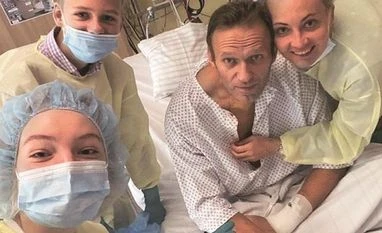
Navalny, anti-corruption investigator who is Russian President Vladimir Putin's most visible foe, was flown to Germany two days after falling ill on August 20 during a domestic flight in Russia. German officials said last month that labs found traces of a Novichok agent in the Russian politician's system. Navalny is now recovering in Germany.
Maas called the attack a serious breach of international law and said Germany will coordinate a response with its European allies and at the OPCW in the coming days.
"It is clear that if the events are not cleared up and the necessary information is not provided, then targeted and disruptive sanctions against those responsible on the Russian side will be unavoidable and Russia would do well not to let this happen, Maas said in Berlin.
He said Germany needs to have talks with the European Union in coming days about possible sanctions targeting individuals linked to chemical weapon development.
Navalny said last week that only Putin could have been behind the attack against him. The Kremlin called that claim absolutely groundless and unacceptable.
A group of 44 OPCW member nations including Germany, the U.K., the United States and France delivered a statement at the organization's Executive Council meeting Tuesday calling on Russia to investigate and to disclose in a swift and transparent manner the circumstances of this chemical weapons attack and share the findings with the OPCW before its next full meeting of member states, scheduled to start on November 30.
Russia's envoy to the OPCW, Ambassador Alexander Shulgin told the meeting that Russia does not owe anything to anybody. Neither to Germany nor to other countries that categorically and groundlessly accuse Russia of poisoning Alexei Navalny. We do not need to explain ourselves to them and we are not going to.
However, Moscow has asked the OPCW to consider sending technical experts to Russia to "cooperate with Russian experts on the matter, Shulgin said. The organisation has said it is willing to help, but needs clarification of Moscow's request before sending experts.
Kremlin spokesman Dmitry Peskov said Wednesday that Russia genuinely wishes to shed light on all the circumstances, reasons and the essence of what happened to Navalny and that Moscow invited OPCW experts to the country specifically so that they can see something here.
Moscow is yet to receive detailed information from the OPCW about its findings, Peskov added. We only know only the main outlines that were published, but there is no specifics there."
The Russian Foreign Ministry on Tuesday night also bristled at the OPCW's findings, calling them part of a conspiracy scenario. The ministry said Russia will lay out its version of events at this week's meeting of the OPCW's Executive Council and present the chronology of backstage manipulation by the main actors in this play.
(Only the headline and picture of this report may have been reworked by the Business Standard staff; the rest of the content is auto-generated from a syndicated feed.)
First Published: Oct 07 2020 | 11:00 PM IST


 Connect with us on WhatsApp