Japan is Asia's naval powerhouse with two aircraft carrier-sized warships

This, with Japanese Ship Kaga's rebirth on Wednesday as a 'helicopter destroyer'
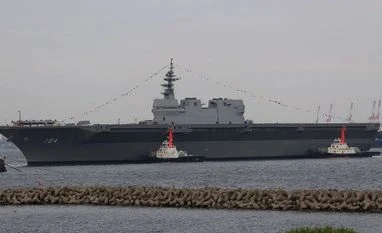
Kaga
Ajai Shukla New Delhi
Last Updated : Mar 24 2017 | 2:36 AM IST

The state-controlled Chinese media has sharply criticised the commissioning of Japan’s powerful new warship, which has the same name --- Kaga --- as one of the Imperial Japanese Navy’s aircraft carriers in World War II. 

The original Kaga, which Beijing’s English language daily, Global Times, terms a “notorious warship”, was sunk by the US Navy in the Battle of Midway in 1942.

With Japanese Ship (JS) Kaga’s rebirth on Wednesday as a “helicopter destroyer”, Japan now has Asia’s only navy with two aircraft carrier-sized warships --- the Kaga and its predecessor, JS Izumo. The 248 metre-long Kaga is larger than the Indian Navy’s INS Vikramaditya.

Additionally, Japan also operates two smaller helicopter destroyers, JS Haga and JS Ise, which are about the same weight class as the “Harrier carriers” that served the Italian, Spanish and Thai navies.

Beijing would also have noted last fortnight’s commissioning of Japan’s eighth Soryu-class submarine --- a massive 4,100-tonne vessel with air independent propulsion that many consider the world’s finest conventional submarine. With 11 older Oyashio-class submarines already in the fleet, Japan would have 23 submarines by 2021, when all 12 Soryu-class vessels are delivered. 

Yet, the Japanese government, headed by the avowedly nationalist Shinzo Abe, still calls its navy the Japanese Maritime Self Defence Force (JMSDF). However, with China aggressively enforcing claims to disputed islands and waters in the Sea of Japan, East China Sea and South China Sea, Tokyo is gradually dropping the pretence.

Reuters has reported that JS Izumo will shortly lead a JMSDF naval task force on a three-month tour of the South China Sea, which the news agency terms the “biggest show of naval power in foreign waters in more than 70 years.”

JS Kaga, like its forerunner, JS Izumo, currently has a compliment of just nine helicopters. However, each vessel can embark 28 small, or 14 large aircraft. The helicopter carriers are not fitted with catapults or ski jumps for launching fixed wing fighters, but they could function as aircraft carriers by embarking vertical take-off fighters like the F-35B Lightening II.

Tokyo has a contradictory position on the use of military force. Its pacifist constitution, imposed on a defeated Japan by a victorious US after World War II, explicitly renounces war. It limits Japan’s defence spending to just one per cent of Gross Domestic Product (GDP) and prohibits it from acquiring offensive weapons platforms like aircraft carriers (helicopter carriers are passed off as defensive platforms).

On the other hand, the US today sees Japan as an ally against a resurgent China. Washington backs unapologetically nationalist leaders like Abe, who argue for shedding the US-imposed restraint. When President Donald Trump argued for allies like Japan to bear more of the cost of their defence he was, in effect, arguing for scuppering Japan’s one per cent spending cap.

Yet the JMSDF, despite its spending restraints, is widely considered Asia’s most powerful navy, even beating out China. Even with the one per cent spending cap, Japan has announced a defence budget for 2017 of $43.6 billion, only marginally smaller than India’s $53.5 billion. 

Unlike India and China, Japan’s army does not consume the bulk of the budget --- the navy and air force do. In contrast, India’s navy was allocated just 14 per cent and the air force 22 per cent of the defence budget.

Furthermore, Japan’s sophisticated shipbuilding industry, including giants like Kawasaki Heavy Industries and Mitsubishi Heavy Industries, churn out warships fast and cheaply. Japan’s latest defence budget reveals they will build a new Soryu-class submarine for $685 million (India’s Scorpene submarines, less than half the Soryu’s size, costs about the same). Japan is building a 690-tonne, Awaji-class ocean minesweeper for just $160 million, and has budgeted $210 million for a 2,900-tonne Hibiki-class ocean surveillance ship.

For over a decade, the US has cajoled India and Tokyo into closer naval cooperation. Last year, Japan formally became a participant in the annual Malabar naval exercise, making it a US-India-Japan trilateral exercise.

There are bilateral proposals between New Delhi and Tokyo for the supply of Japanese defence equipment to India --- a touchy subject, given Japan’s constitution. On the table is the Japanese maritime sea-plane, the US-2; and the Soryu submarine.

One subscription. Two world-class reads.

Already subscribed? Log in

Subscribe to read the full story →
*Subscribe to Business Standard digital and get complimentary access to The New York Times

Smart Quarterly

₹900

3 Months

₹300/Month

SAVE 25%

Smart Essential

₹2,700

1 Year

₹225/Month

SAVE 46%
*Complimentary New York Times access for the 2nd year will be given after 12 months

Super Saver

₹3,900

2 Years

₹162/Month

Subscribe

Renews automatically, cancel anytime

Here’s what’s included in our digital subscription plans

Exclusive premium stories online

  • Over 30 premium stories daily, handpicked by our editors

Complimentary Access to The New York Times

  • News, Games, Cooking, Audio, Wirecutter & The Athletic

Business Standard Epaper

  • Digital replica of our daily newspaper — with options to read, save, and share

Curated Newsletters

  • Insights on markets, finance, politics, tech, and more delivered to your inbox

Market Analysis & Investment Insights

  • In-depth market analysis & insights with access to The Smart Investor

Archives

  • Repository of articles and publications dating back to 1997

Ad-free Reading

  • Uninterrupted reading experience with no advertisements

Seamless Access Across All Devices

  • Access Business Standard across devices — mobile, tablet, or PC, via web or app

Next Story


