Nobel Peace Prize 2015 goes to Tunisian National Dialogue Quartet

The conglomerate comprises four organisations that helped establish a peaceful and constitutional system of government in a country that was on the brink of civil war
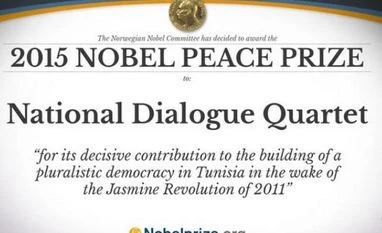
2015 Nobel Peace Prize awarded to the Tunisian National Dialogue Quartet
BS Web Team Mumbai
Last Updated : Oct 09 2015 | 4:59 PM IST
The 2015 Nobel Peace Prize has been awarded to the Tunisian National Dialogue Quartet—a conglomerate of four organisations that represent the different aspects of Tunisian society—“for its decisive contribution to the building of a pluralistic democracy in Tunisia in the wake of the Jasmine Revolution of 2011.” The Norwegian Nobel Committee on its website states that the Quartet was formed in 2013 when Tunisia was on the verge of a civil war. It helped the country establish a constitutional system of government that guaranteed the fundamental rights of each and every citizen.
 
The Quartet comprises of four organisations— the Tunisian General Labour Union (UGTT, Union Générale Tunisienne du Travail), the Tunisian Confederation of Industry, Trade and Handicrafts (UTICA, Union Tunisienne de l’Industrie, du Commerce et de l’Artisanat), the Tunisian Human Rights League (LTDH, La Ligue Tunisienne pour la Défense des Droits de l’Homme), and the Tunisian Order of Lawyers (Ordre National des Avocats de Tunisie).

Tunisia was the birthplace of the Arab Spring, which spread to several other countries in North Africa and the Middle East. While some of these countries are still struggling to establish democracy and fundamental rights, Tunisia has transitioned into a vibrant civil society that ensures the basic human rights for its citizens.

The Quartet played a crucial role in countering the spread of unrest and disharmony in Tunisia by helping the people, the political parties and authorities achieve consensus on various challenges across political and religious divides.

The Nobel Committee
states in its press release, “The course that events have taken in Tunisia since the fall of the authoritarian Ben Ali regime in January 2011 is unique and remarkable for several reasons. 
 
Firstly, it shows that Islamist and secular political movements can work together to achieve significant results in the country’s best interests. The example of Tunisia thus underscores the value of dialogue and a sense of national belonging in a region marked by conflict. 
 
Secondly, the transition in Tunisia shows that civil society institutions and organizations can play a crucial role in a country’s democratization, and that such a process, even under difficult circumstances, can lead to free elections and the peaceful transfer of power. The National Dialogue Quartet must be given much of the credit for this achievement and for ensuring that the benefits of the Jasmine Revolution have not been lost.”
 
(With inputs from Nobelprize.org)
*Subscribe to Business Standard digital and get complimentary access to The New York Times

Smart Quarterly

₹900

3 Months

₹300/Month

SAVE 25%

Smart Essential

₹2,700

1 Year

₹225/Month

SAVE 46%
*Complimentary New York Times access for the 2nd year will be given after 12 months

Super Saver

₹3,900

2 Years

₹162/Month

Subscribe

Renews automatically, cancel anytime

Here’s what’s included in our digital subscription plans

Exclusive premium stories online

  • Over 30 premium stories daily, handpicked by our editors

Complimentary Access to The New York Times

  • News, Games, Cooking, Audio, Wirecutter & The Athletic

Business Standard Epaper

  • Digital replica of our daily newspaper — with options to read, save, and share

Curated Newsletters

  • Insights on markets, finance, politics, tech, and more delivered to your inbox

Market Analysis & Investment Insights

  • In-depth market analysis & insights with access to The Smart Investor

Archives

  • Repository of articles and publications dating back to 1997

Ad-free Reading

  • Uninterrupted reading experience with no advertisements

Seamless Access Across All Devices

  • Access Business Standard across devices — mobile, tablet, or PC, via web or app

More From This Section

First Published: Oct 09 2015 | 2:52 PM IST

Next Story