
Our vaccine will continue to protect against Covid-19 variants: Pfizer
The firm cited recent neutralisation data
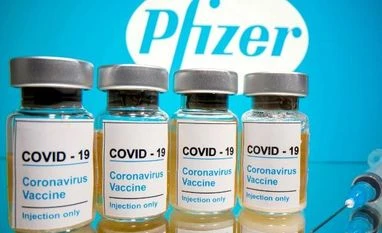 "Our vaccine will continue to protect against Covid-19 variants: Pfizer")
WebinarsNew
Deep DiveNew
Explore Business Standard
The firm cited recent neutralisation data
Pfizer said on Thursday said that neutralisation against the B.1.617 variant of coronavirus is being tested as part of its ongoing monitoring activities.
It said a recent real-world study in subjects who had received two doses of the Pfizer-BioNTech COVID-19 vaccine demonstrated 75 per cent effectiveness against any documented infection by the B.1.351 variant and 100 per cent against that by B.1.351[1], the variant first identified in South Africa.
The US pharma company said neutralization data provide strong support that "our vaccine will continue to protect against these variants".
B.1.617 variant of coronavirus was first found in India.
"To date, we are encouraged by both the real-world data and laboratory studies of Pfizer's COVID-19 vaccine and see no evidence that the virus or circulating variants of concern regularly escape protection. Neutralisation against the B.1.617 variant of coronavirus is being tested as part of Pfizer's ongoing monitoring activities," the statement said.
It said Pfizer recently conducted a study with the University of Texas to understand the neutralising activity of BNT162b2-elicited serum against SARS-CoV-2 variants of concern. The preprint server Research Square has published a manuscript from the study.
The company said that in the study, Pfizer and the University of Texas Medical Branch genetically engineered viruses with spike protein mutations found in the newly emerged B.1.617 or B.1.525 lineages. The viruses were then tested against a panel of sera from participants in the previously reported Phase 3 trial who had been immunized with the Pfizer-BioNTech COVID-19 vaccine.
"All the sera neutralised all the viruses tested. Additionally, a recent real-world study in subjects who had received two doses of the Pfizer-BioNTech COVID-19 vaccine demonstrated the effectiveness of 75 per cent against any documented infection by the B.1.351 variant and 100 per cent against documented severe, critical, or fatal disease caused by the variant B.1.351[1] (the variant first identified in South Africa), which shows a similar reduction of neutralisation titers (titer is a laboratory test that measures the presence and amount of antibodies in blood) as B.1.617.1," it said.
"This indicates that reductions in neutralisation like that observed for B.1.617.1 varaint are unlikely to result in loss of vaccine efficacy," it added.
(Only the headline and picture of this report may have been reworked by the Business Standard staff; the rest of the content is auto-generated from a syndicated feed.)
First Published: May 27 2021 | 5:04 PM IST


 Connect with us on WhatsApp