Trump pledges 'big number' on Dodd-Frank in anti-rule push

There were $310 billion in loans outstanding to small business before the law was passed
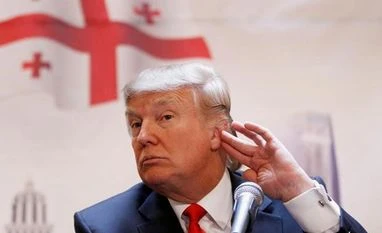
Donald Trump, us president
Donald Trump speaks to the press during an announcement in New York. Photo: Reuters
Ben BainJesse Hamilton/ Bloomberg
Last Updated : Feb 01 2017 | 12:20 AM IST
President Donald Trump stepped up his criticism of financial regulations, pledging to go after the 2010 Dodd-Frank banking overhaul because he said the law has made it difficult for businesses to get loans.

“We’re going to be doing a big number on Dodd-Frank," Trump said Monday at an event with small business leaders at the White House. He called the legislation “a disaster" and said, “it’s almost impossible now to start a small business and it’s virtually impossible to expand your existing business.”

Trump didn’t provide data linking borrowing to Dodd-Frank, and the law’s impact on business lending isn’t clear cut. Commercial and industrial lending is up significantly since the law was approved, though the amount of money lent to small businesses was little changed, according to government data.

Trump’s remarks are his most pointed on financial rules since he took office January 20. His advisors vowed to dismantle Dodd-Frank during the transition period, but have provided scant details on how they plan to go about it. Trump didn’t say whether he planned to attack the law through executive action or by working with Congress on legislation.

Banks and investors have been trying to decipher how the billionaire will balance his populist message to the middle class with his Wall Street ties, which include a cadre of former Goldman Sachs Group bankers he’s tapped for key roles in his administration.

The president’s comments came as he signed an executive order requiring that government agencies revoke two existing regulations for each new one they issue, fulfilling a campaign promise. Trump campaigned on cutting a federal bureaucracy that he blames for making it harder for businesses to grow and get funding.

Key lending portfolios have been on the rise since former President Barack Obama signed Dodd-Frank into law in July 2010. At the time, commercial and industrial lending was at $1.2 trillion, according to data from the Federal Reserve. Almost seven years later, that measure of credit from US banks to the business sector is up almost 70 per cent to $2.1 trillion.

There were $310 billion in loans outstanding to small business before the law was passed, according to Federal Deposit Insurance. As of the end of September, those loans totaled $328 billion. While there was a dollar value increase, those loans grew at a far slower pace than larger business loans and nominal gross domestic product. The FDIC defines small business loans as those totaling $1 million or less.

Justin Schardin, an analyst at the Bipartisan Policy Center in Washington who focuses on financial regulation, said it’s unclear how much the 2010 law has directly affected lending to small businesses. “It’s worth looking at all different types of lending to see what impact post-crisis reforms have had,” he said.

Getting Congress to make big changes to the 2010 banking law won’t be easy. While House Republicans, led by Jeb Hensarling, chairman of the House Financial Services Committee, is working on a measure that would rip apart most of Dodd-Frank, the Senate Banking Committee hasn’t proposed its own version. Most legislation would require support from at least some Democrats in the Senate to avoid filibuster rules, unless lawmakers try to attach parts of it to a fast-track budget process.

Asked whether Trump would seek to change Dodd-Frank through legislation or executive action, the president’s spokesman, Sean Spicer, offered no clarity. He told reporters Monday in Washington that Trump would "continue to work with Congress" on changing the law. 

A Look at numbers

Trump says the law has made it difficult for businesses to get loans. Here is what Federal Deposit Insurance says: 

Key lending portfolios have been on the rise since former President Barack Obama signed  Dodd-Frank into law in July 2010

At the time, commercial and industrial lending was at $1.2 trillion

Almost seven years later, that measure of credit from US banks to the business sector is up almost 70 per cent to $2.1 trillion

There were $310 billion in loans outstanding to small business before the law was passed

As of the end of September, those loans totalled $328 billion

One subscription. Two world-class reads.

Already subscribed? Log in

Subscribe to read the full story →
*Subscribe to Business Standard digital and get complimentary access to The New York Times

Smart Quarterly

₹900

3 Months

₹300/Month

SAVE 25%

Smart Essential

₹2,700

1 Year

₹225/Month

SAVE 46%
*Complimentary New York Times access for the 2nd year will be given after 12 months

Super Saver

₹3,900

2 Years

₹162/Month

Subscribe

Renews automatically, cancel anytime

Here’s what’s included in our digital subscription plans

Exclusive premium stories online

  • Over 30 premium stories daily, handpicked by our editors

Complimentary Access to The New York Times

  • News, Games, Cooking, Audio, Wirecutter & The Athletic

Business Standard Epaper

  • Digital replica of our daily newspaper — with options to read, save, and share

Curated Newsletters

  • Insights on markets, finance, politics, tech, and more delivered to your inbox

Market Analysis & Investment Insights

  • In-depth market analysis & insights with access to The Smart Investor

Archives

  • Repository of articles and publications dating back to 1997

Ad-free Reading

  • Uninterrupted reading experience with no advertisements

Seamless Access Across All Devices

  • Access Business Standard across devices — mobile, tablet, or PC, via web or app

Next Story



