
Wall St rallies on 'fear of missing out' despite looming political risks
Alongside the back-and-forth on taxes, Wall Street will be watching a Dec 8 expiration date for funding needed to keep the US govt open
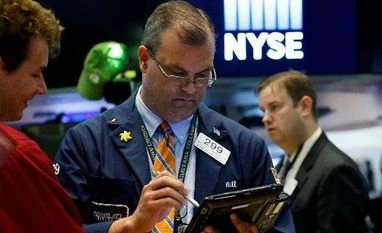 "Wall St rallies on 'fear of missing out' despite looming political risks")
Explore Business Standard
Alongside the back-and-forth on taxes, Wall Street will be watching a Dec 8 expiration date for funding needed to keep the US govt open
Wall Street's fear of missing out on a relentless rally appears to be trumping rising political risk in a high-stakes December in Washington.
The ticking clock on the Republican Party's efforts to cut corporate taxes, alongside the risk that the US government may shut down if a budget deal isn't reached by December 8, is increasing the levels of political risk for investors - but they have yet to really react.
"Right now the market is assuming that everything will work out, but you've got a tremendous number of moving parts," said Phil Orlando, chief equity market strategist at Federated Investors in New York.
Alongside the back-and-forth on taxes, Wall Street will be watching a Dec. 8 expiration date for funding needed to keep the US government open alongside the deadline when the US Treasury hits its limit on borrowing; as well as a Dec. 12 Special US Senate election in Alabama.
On Tuesday, President Donald Trump warned on Twitter that "I don't see a deal" to keep the government open and work past Dec. 8, although the White House said Wednesday it did not see such an eventuality.
Typically, the threat of a government shutdown alone would prompt fund managers to move more of their assets into cash. The benchmark S&P 500 lost 2.6 per cent in the eight trading days before the last government shutdown in 2013, and has declined an average of 0.6 per cent during government shutdowns overall, according to LPL Financial. Debt limit concerns are likely to be put off until 2018 as the U.S. Treasury is expected to take steps to postpone any need for action by Congress.
Yet with the benchmark S&P 500 up nearly 18 per cent for the year to date, some portfolio managers see a greater risk in stepping to the sidelines. Throughout the year, the stock market has rallied in the face of standoffs ranging from increasing tensions in North Korea to former FBI director's James Comey's testimony to Congress that President Trump fired him to undermine the agency's Russia investigation.
On Friday, stocks sold off on a report that former national security adviser Michael Flynn was prepared to tell investigators that before taking office Trump had directed him to make contact with Russians. However, shares quickly pared those losses.
Despite his skepticism, Orlando has yet to move more of his assets to cash, in large part because corporate earnings keep rising and should continue to do so even if a tax package is not signed, he said.
If the tax bill fails, Orlando said he expected the S&P 500 to fall by as much as 10 percent. He would be a buyer in that case, he said, because he expected the S&P 500 to reach 3000 within the next 18 months.
CROWDED CALENDAR
Brian Peery, a portfolio manager at Novato, California-based Hennessy Funds, said a government shutdown or the tax bill failing would prompt a swift sell-off, but that rising consumer confidence would ultimately continue to push the market higher over the next year.
"If I'm looking at a 10 per cent correction, I'm a buyer," he said.
The inaction is not limited to the stock market.
Christopher Ryon, a municipal bond fund manager at Santa Fe, New Mexico-based Thornburg Investment Management, said that the Republican tax bill could reduce the size of the municipal bond market by 25 to 30 percent by limiting the ability of stadiums, airports and privately-financed toll roads to qualify for tax-exempt status.
At the same time, there could be an increased demand for municipal bonds if residents of high-tax states are no longer able to deduct their full state and local property taxes, leaving tax-free municipal bonds as one of the few ways wealthy investors can reduce their taxable incomes.
As a result, Ryon is largely sitting on his hands, ignoring both lower-rated bonds that have rallied as investors have reached for yield and triple A rated bonds that look "on the rich side," he said.
"There are a whole lot of unintended consequences attached to this [tax] legislation," Ryon said. "This is going to be an interesting couple of weeks where we will really see how the sausage gets made."
First Published: Dec 02 2017 | 9:57 AM IST

