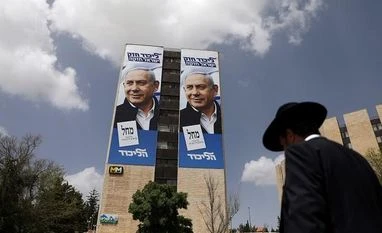
Gantz has emerged as a serious rival to Netanyahu. His party is forecast to win 31 seats. Gantz is a popular former armed forces chief and a political newcomer. He joined forces with the right-wing Moshe Yaalon, a former defence minister, and centre-left former finance minister Yair Lapid to form the new centrist Blue and White party. Gantz has called for pursuing peace with the Palestinians while maintaining Israeli security interests. He has signalled he would make territorial concessions toward the Palestinians but has also sidestepped the question of Palestinian statehood. Gantz has vowed clean government, while at the same time giving mixed signals over whether he would join a Netanyahu-led coalition.
Bennett, Israel's education minister, and Justice Minister Shaked split from Israel's national-religious faction to form a new far-right party that would appeal to more secular constituents. Polls presently show them winning 6 seats. Bennett calls for annexing most of the West Bank, offering autonomy to Palestinians. Shaked has vowed to "reign in" Israel's supreme court which she has branded as too liberal and interventionist.
Predicted to win 7 seats, Israel's national-religious party is the most prominent political representative of Israeli settlers in the West Bank. It repudiates the idea of a Palestinian state and stresses Israel's biblical and religious connections to land Palestinians seek for a state. The union includes Jewish Power, an ultra-nationalist religious party that includes disciples of the late Rabbi Meir Kahane who advocated the "transfer" of Palestinians to neighbouring Arab countries and a ban on intermarriage between Jews and Arabs.
A former Likud member, Kahlon has partly come through on his pledge to halt soaring housing prices but has fallen short on dramatically reducing overall living costs. His party casts itself as moderate right-wing and has focused its campaign on socio-economic issues. Kulanu is expected to win only half of its current 10 seats.
The far-right party, which has counted on the support of immigrants from the former Soviet Union, has been teetering on the electoral threshold in recent polls. Moldovan-born Lieberman is a former defence minister whose policies include trading Arab towns in Israel to any future Palestinian state for territory in the West Bank where Jewish settlements have been built. He also wants to make loyalty to the state a condition for citizenship.
Allied with UTJ, SHAS (an acronym for Union of Sephardic Torah Observers) has like UTJ been an almost permanent fixture in successive governments and represents Haredi Jews of Middle Eastern origin. According to opinion polls, it will win 5-6 seats in parliament.
Predicted to take 7-8 seats in the Knesset, the socialist Jewish-Arab party draws most of its voters from Israel's 20 percent Arab minority. It advocates an Arab-Jewish alliance to fight discrimination, racism and social inequality in Israel.
One subscription. Two world-class reads.
Already subscribed? Log in
Subscribe to read the full story →
Smart Quarterly
₹900
3 Months
₹300/Month
Smart Essential
₹2,700
1 Year
₹225/Month
Super Saver
₹3,900
2 Years
₹162/Month
Renews automatically, cancel anytime
Here’s what’s included in our digital subscription plans
Exclusive premium stories online
Over 30 premium stories daily, handpicked by our editors


Complimentary Access to The New York Times
News, Games, Cooking, Audio, Wirecutter & The Athletic
Business Standard Epaper
Digital replica of our daily newspaper — with options to read, save, and share


Curated Newsletters
Insights on markets, finance, politics, tech, and more delivered to your inbox
Market Analysis & Investment Insights
In-depth market analysis & insights with access to The Smart Investor


Archives
Repository of articles and publications dating back to 1997
Ad-free Reading
Uninterrupted reading experience with no advertisements


Seamless Access Across All Devices
Access Business Standard across devices — mobile, tablet, or PC, via web or app
)