For all the drama of knife-edge votes in Parliament, the sniping and sabotage, the resignations and political insurrections, Britain is now staring at a hard truth. Its deadline for exiting the European Union is less than nine months away. And there is no workable plan in sight.
The political fight is so noisy, stoked by a partisan British news media, that it is easy to forget what could be coming if no agreement is made: a disorderly divorce, the so-called “cliff-edge” scenario — as in the country could metaphorically fall off one. Trucks stuck at ports. Supermarket shelves emptying out. Planes grounded at airports, and millions of citizens trapped in legal limbo.
This week, in a sign of mounting anxiety, the British government announced plans to issue regular warnings to citizens and businesses — likely to range from how to prevent medicine shortages to what documents would be needed to drive in France — so that everyone can prepare for the chance that a deal will not be struck. A no-deal divorce would be so dire that many politicians quietly believe it will be avoided and common sense will prevail.
The question is how. Parliament is paralyzed. Prime Minister Theresa May is besieged. Her Conservatives are bitterly divided, consumed by infighting, while the opposition Labour Party keeps its head down, hoping to exploit the chaos.
There are factions pushing to hold a second Brexit referendum that might reverse the first — except doing that would provoke a backlash among supporters of withdrawal. There is speculation about a general election to produce a new government with a clear majority — but that didn’t work last June.
There is also talk, ceaselessly, of a leadership challenge to May — yet her critics seemingly lack the numbers to be sure of deposing her. This week there was even talk of a national unity government.
Though President Trump seemed to offend almost everyone during his visit to Britain last week, his depiction of a country in “somewhat turmoil” was not completely wrong.
“Basically nobody has the faintest idea what will happen,” said Charles Grant, director of the Center for European Reform, a research institute. “The risk is real of political deadlock in Britain with Britain drifting toward the cliff edge.”
For the moment, the European Union also seems to be preparing for chaos. This week, the European Commission, its executive arm, issued an urgent advisory for member countries to prepare for “all outcomes.”
In the worst case, that would mean suddenly reimposing the types of checks that exist at many borders. That could include customs inspections usually meant to decide if tariffs need to be paid and other checks to decide if food and medicine meet the safety standards of the country where the goods are going.
For months, the consuming political narrative has been the fight within the Conservative Party. The Tories are divided between those who want a “hard Brexit,” a clean break from European rules, and those who want to protect the economy and soften the impact of departure. But within these competing camps are factions, which are making it harder to reach any kind of solution.
Given the prospect of economic chaos on both sides of the English Channel, Simon Fraser, a former top career official in Britain’s Foreign Office who is now managing partner at a consultancy, Flint Global, said that “the calculation has to be that it is in the interests of both sides to reach a deal.”
“But sitting here today,” he added, “one can’t yet see how the deal will be done.”
The breakthrough was supposed to have come earlier this month, when May summoned her divided cabinet to Chequers, the prime minister’s country residence. There, she presented a white paper — her Chequers plan — that aims to soften the economic impact of Brexit by keeping some close ties to the bloc and maintaining European rules for trade in goods at least.
The cabinet approved, and the hard-liners appeared to be routed.
But the hard Brexit camp digested the deal and spat it back out, with several ministers resigning, including Boris Johnson, who quit as foreign secretary. Parliament came close to deadlock.

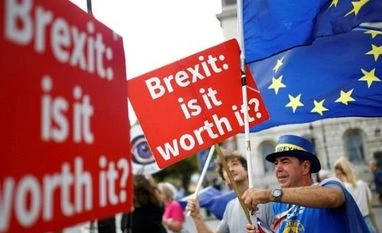 "With deadline lurking & Brexit talks deadlocked, UK in race against time")












 Connect with us on WhatsApp