Your move, Mr Trump: Ball in US court as China hits back in trade war

Experts panned Trump's strategy of using tariffs to attempt to curb China's manufacturing rise
trade war, Trump, Donald trump, united states
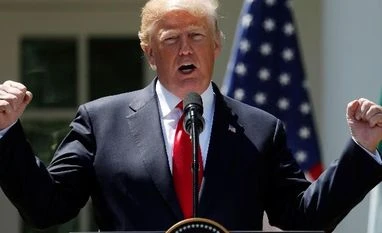
US President Donald Trump gestures while addressing a joint news conference with Nigeria's President Muhammadu Buhari in the Rose Garden of the White House in Washington, US | Photo: Reuters
Jeffrey Black | Bloomberg
Last Updated : Jun 17 2018 | 12:52 AM IST
China’s in-kind response to US President Donald Trump’s announcement of tariffs on $50 billion of imports from the nation left the global economy on the verge of a trade war.
 
Two detailed lists of products on which tariffs will be collected starting July 6 now form the core of the conflict between the world’s two largest economies: One released Friday aimed at curbing China’s industrial advancement and the other aimed at hurting the commodity producers of the American heartland.

China’s response, released in detail early Saturday, now raises the prospect the US will impose more duties following a pledge from Trump on Friday. For now, weeks of shuttle diplomacy between Washington and Beijing, in an effort to reduce China’s massive goods trade surplus with the US, have produced nothing -- and the very products that China had pledged to buy more of will now be slapped with higher import duties instead.
 
“There is very little chance that this three-week delay to July 6 will allow for a last-ditch effort to avert tariffs,” said economists including Michael Hirson, Asia director at Eurasia Group in New York. “The first round of tariffs on $50 billion in goods is locked in and the risk of escalation to a second round is considerable.”

The US Trade Representative’s final list includes 1,102 product lines, down from about 1,300 initially, mainly focused on China’s Made In 2025 plan to become dominant in high-technology industries such as robotics, aerospace, industrial machinery and automobiles. Consumer goods including mobile phones and televisions aren’t being subjected to the tariffs.

Hours after the US announcement -- China’s Finance Ministry issued a list of 545 product categories, also covering about $34 billion in exports from the US, to be subject to an additional 25 per cent tariff starting July 6. They included a variety of agricultural products, including soybeans, corn and wheat along with beef, pork and poultry, plus automobiles. A second set of tariffs to begin at a later date covered other goods including coal, crude oil, gasoline and medical equipment.
 
The US imported $506 billion of goods from China last year and exported about $130 billion, leaving a 2017 deficit of $376 billion, according to government figures.
 
Experts panned Trump’s strategy of using tariffs to attempt to curb China’s manufacturing rise. While the USTR list does target exports of Chinese goods that are the building blocks to becoming an advanced industrial power, there’s little evidence that the tariffs will have enough effect to prevent the nation moving into more advanced fields.
 
“The mentality of the Trump team is a little strange,” said Andrew Polk, co-founder of research firm Trivium China in Beijing. “They’re saying, ‘We’re going to tax exports from China where they want to be a global superpower,’ he said.
 
“A much more powerful way to stop China from moving up the value chain is to stop selling them semiconductors,” Polk added.
China has leverage over key exports from US states that voted for Trump in 2016. In April, the Asian nation started levying additional taxes on American fruit, nuts, pork and wine in response to Trump tariffs on steel and aluminium. Products affected include soy, corn, wheat, rice, sorghum, beef, pork, poultry, fish, dairy products, nuts and vegetables.
 
The Chinese list released Saturday covers almost all farm products imported from the US, said Li Qiang, chief analyst with Shanghai JC Intelligence Co. Ltd. “Given China’s big trade surplus with the US, it will be more difficult and complicated for China” in the future to retaliate if the Trump administration expands the tariffs to more products, said Li. The new list includes more agricultural products, including dairy, alfalfa and seafood, than an initial group published in April.
 
Escalation looms. In April, Trump asked officials to consider an additional $100 billion in levies. Meanwhile, US Trade Representative Robert Lighthizer said an announcement on US investment restrictions on China will follow in the next two weeks.
 
Trump’s tariffs may also influence his efforts to bring peace to the Korean peninsula following his summit with leader Kim Jong Un this week in Singapore. Beijing is an important player in talks with North Korea on abandoning its nuclear-weapons program.
 
“While the end game is a compromise trade deal that meets US demands for stronger Chinese protection of intellectual property rights, the road to a trade deal has become very ugly,” said Rajiv Biswas, APAC chief economist at IHS Markit in Singapore. “Both US and Chinese exporters will suffer considerable economic losses while these punitive tariffs are in place, and many Asian countries that are part of the Chinese manufacturing supply chain will also suffer collateral damage in this escalating trade war.”
@2018Bloomberg

One subscription. Two world-class reads.

Already subscribed? Log in

Subscribe to read the full story →
*Subscribe to Business Standard digital and get complimentary access to The New York Times

Smart Quarterly

₹900

3 Months

₹300/Month

SAVE 25%

Smart Essential

₹2,700

1 Year

₹225/Month

SAVE 46%
*Complimentary New York Times access for the 2nd year will be given after 12 months

Super Saver

₹3,900

2 Years

₹162/Month

Subscribe

Renews automatically, cancel anytime

Here’s what’s included in our digital subscription plans

Exclusive premium stories online

  • Over 30 premium stories daily, handpicked by our editors

Complimentary Access to The New York Times

  • News, Games, Cooking, Audio, Wirecutter & The Athletic

Business Standard Epaper

  • Digital replica of our daily newspaper — with options to read, save, and share

Curated Newsletters

  • Insights on markets, finance, politics, tech, and more delivered to your inbox

Market Analysis & Investment Insights

  • In-depth market analysis & insights with access to The Smart Investor

Archives

  • Repository of articles and publications dating back to 1997

Ad-free Reading

  • Uninterrupted reading experience with no advertisements

Seamless Access Across All Devices

  • Access Business Standard across devices — mobile, tablet, or PC, via web or app

Next Story


