There is a spot where the warm aroma of fresh baking catches hold of anyone travelling in a Mumbai local train enroute Andheri and further north. A result of the busy ovens at the first factory of Parle Products baking a batch of the world's largest biscuit brand, Parle G. The company makes 400 million of those a day.
Parle Products was established in 1929 to manufacture confectionery such as boiled sweets, after the promoter family, the Chauhans, bought a decrepit factory. Parle G was born as Parle Gluco a decade later, even as the bugle for World War II was sounded.
Parle had to manufacture military-grade biscuits for British soldiers right after, but ensured that it could manufacture the nutritional Parle G for the common masses.
Parle G, as we know it today, has grown to be bigger than any other biscuit brand in the world by carrying forward the same positioning from the thirties, perfected over the years with a resourceful knack for scale and self-sufficiency. Launched as an affordable source of nourishment (it underlined the calories in a pack at one time) to counter expensive, imported biscuits in the British Raj such as Jacob's (cream cracker of United Biscuits) and those of erstwhile large biscuit maker, Huntly & Palmers. Britannia, then based out of Calcutta (Kolkata now), was strong in the east, while Glaxo glucose biscuit, also imported, ruled over the south.
Kamal Kapadia, who worked at Parle for 32 years and left as CEO, Bengaluru project, in 2004, says, "There were many local manufacturers in the early years, mostly cottage industries. Biscuits then would first mean glucose biscuits."
Kapadia recalls that in 1960, Britannia launched its first glucose biscuit brand, Glucose D, later endorsed by Amjad Khan's Sholay avatar, Gabbar Singh in the 1970s.
It was then that Parle Gluco started feeling the heat, even smaller players would imitate the pack and carry the suffix of 'glucose' in their names. People, especially who were not literate would just ask for glucose biscuits.
Munawar Syed, who worked on the Parle account from the seventies till the nineties, at Everest (now director at Triton), says, "People were confused by similar brand names. Glucose became generic. We did advertise the differences but then, took a call to change the name and ride more on Parle." In 1982, Parle Gluco was repackaged as Parle G. The company had earlier tried to battle knock-offs by imprinting the plump little girl (an illustration by Everest) on its packs, in the mid-seventies. It clicked with Parle G's target audience, kids and their mothers.
Kapadia says Parle always believed in branding: "I still remember Parle G's taglines such as 'Often imitated, never equalled'". Parle was among the first advertisers to paint Mumbai's train compartments with Parle Gluco ads when the Indian Railways allowed it.
It was the belief in branding that also made Parle G's makers self-reliant, build scale and maintain pricing. Kapadia says, "It wanted to sell biscuits in consumer-friendly packs, rather than leave them loose in jars." Parle resorted to importing and patenting its own packing machinery as early as the fifties.
Praveen Kulkarni, general manager, marketing, and with the company since mid-90s, says, "Parle G, till the 1980s commanded over 95 per cent. The glucose market was 60-70 per cent of the overall market." Glucose is now 22 per cent of Rs 24,000 crore and Parle G is around 80 per cent of it, reaching 6 million outlets.
While Kulkarni says owing to governmental restrictions on ramping up capacity, Parle G's supply had to be rationed by 20 per cent. In 1997, Britannia relaunched Glucose D as Tiger and filled gaps left by Parle G's short supply. Till its second factory came up in 2000, Parle turned to contract manufacturers.
Parle G has also kept pricing in check, though not always leaving it unscathed. Even when the key ingredient prices (vanaspati, sugar and wheat) went north, its price hovered at Rs 4 for a pack. Kapadia says, "It helped that it had everything in-house - packaging, procurement. And, the owners were hands-on."
However, with aspirations, biscuit consumption has moved to new premium formats. Even with increased penetration, glucose's share has declined.
Parle Products revamped Parle G with the help of O&M, positioning it as aiding intelligent curiosity with the tagline, G for Genius. But Kulkarni admits that it is time to rejuvenate Parle G to appeal to the new generation, who perhaps don't have stories about the brand that is all-too familiar for older generations.

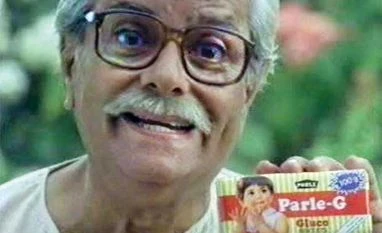 "40 years ago...And now: Parle G tackled crunch with price and reach")

