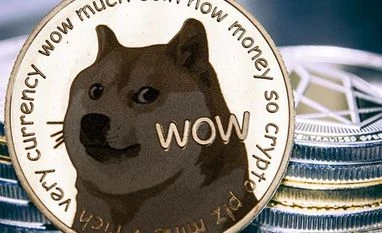
One of the most difficult problems in finance right now is figuring out the fundamental economic value of cryptocurrencies. And the past week has complicated this further.
For many cryptocurrency investors, the value of Bitcoin is based on the fact it is artificially scarce. A hard cap on âmintingâ new coins means there will only ever be 21 million Bitcoin in existence. And unlike national currencies such as the Australian dollar, the rate of release for new Bitcoin is slowing down over time.
Dogecoin, a cryptocurrency that takes its name and logo from a Shiba Inu meme that was popular several years ago, doesnât have a cap. Launched in 2013, there are now 100 billion Dogecoin in existence, with as many as five billion new coins minted each year.
But how can a currency with a seemingly unlimited supply have any value at all? And why did Dogecoinâs price suddenly surge more than 800% in 24 hours on January 29?
At the time of publication, the âmemecoinâ was worth about A$5.6 billion on the stockmarket.
A long-running joke brought to life
Dogecoin is one of the original âaltcoinsâ: cryptocurrencies released in the few years after the pseudonymous Satoshi Nakamoto first released Bitcoin into the wild.
From a technical perspective, Dogecoin isnât very innovative. Like many early altcoins, itâs based on the original source code of Bitcoin.
Or more technically, itâs based on Litecoin, which in turn was based on Bitcoin â but with some small modifications such as faster transactions and the removal of the supply cap. But Dogecoin is much more interesting when seen through a cultural lens.
The cryptocurrency was created by software engineers Billy Markus and Jackson Palmer â although Palmer, an Australian, has since walked away from the project. They branded it with the Doge meme partly to be funny, but also to distance it from Bitcoinâs then questionable reputation as a currency for illicit transactions.
Now, Dogecoin has outlasted almost all the early derivative altcoins and has a thriving community of investors. In 2014, Dogecoin holders sponsored the Jamaican Bobsled Team. Soon after, they sponsored a NASCAR driver.
Â
Elon Musk, the worldâs richest man, is among the cryptocurrencyâs high-profile advocates. In December last year, a tweet from Musk sent Dogecoinâs price soaring.
Collectivism leads to creativity
Reddit threads proclaim Dogecoinâs value as a new global currency. Musk himself shared a similar sentiment a few days ago. Speaking on the app Clubhouse, he said:
Dogecoin was made as a joke to make fun of cryptocurrencies, but fate loves irony. The most ironic outcome would be that Dogecoin becomes the currency of Earth in the future.
But Dogecoin is best thought of as a cultural product, rather than a financial asset. The reality is few cryptocurrency users hold it as a serious investment or to use in regular transactions. Instead, to own Dogecoin is to participate in a culture.
People buy it because itâs fun to have, is inherently amusing and comes with a welcoming and enjoyable community experience.
If we start thinking of the cryptocurrency as a cultural product, last weekâs sudden jump in Dogecoinâs price makes sense. The boost came just after a meme-centric community managed to drive the share price of videogame retailer GameStop from US$20 to US$350 in mere days.
This swarm behaviour was unlike anything seen before â and it frightened global financial markets.
One particularly interesting aspect of the Reddit forum r/WallStreetBets â which coordinated the attack on the hedge fund that had effectively bet on GameStopâs share price falling â was how many users were having fun.
Itâs no surprise activity surrounding Dogecoin has a similar vibe; it was designed to be fun right from the start.
Â
Doge: icon of the internet
Some people participate in financial markets as a form of consumption â meaning for entertainment, leisure and to experience community â just as much as they do for investment.
Cultural assets such as Dogecoin are hard to systematically value when compared to financial assets, a bit like how we donât have a fundamental theorem for pricing art.
Almost by definition, the demand for a memecoin will fluctuate as wildly as internet culture itself does, turning cultural bubbles into financial bubbles. RMIT professor and crypto-ethnographer Ellie Rennie calls these âplayful infrastructuresâ.
By inspecting Dogecoin closely, we can learn a lot about the interplay of technology, culture and economics.
Â
Moreover, cryptocurrencies are extraordinarily diverse. Some are built for small payments or to be resilient holders of value. Others protect financial privacy or act as an internal token to manage smart contracts, supply chains or electricity networks.
Under the hood, Bitcoin and Dogecoin look almost exactly the same. Their code differs in only a few parameters. But their economic functions are almost entirely opposite.
Bitcoin is a kind of âdigital goldâ adopted as a secure hedge against political and economic uncertainty. Dogecoin, on the other hand, is a meme people add to their digital wallet because they think itâs funny. But in an open digital economy, memes move markets.
One subscription. Two world-class reads.
Already subscribed? Log in
Subscribe to read the full story â
Smart Quarterly
âč900
3 Months
âč300/Month
Smart Essential
âč2,700
1 Year
âč225/Month
Super Saver
âč3,900
2 Years
âč162/Month
Renews automatically, cancel anytime
Hereâs whatâs included in our digital subscription plans
Exclusive premium stories online
Over 30 premium stories daily, handpicked by our editors


Complimentary Access to The New York Times
News, Games, Cooking, Audio, Wirecutter & The Athletic
Business Standard Epaper
Digital replica of our daily newspaper â with options to read, save, and share


Curated Newsletters
Insights on markets, finance, politics, tech, and more delivered to your inbox
Market Analysis & Investment Insights
In-depth market analysis & insights with access to The Smart Investor


Archives
Repository of articles and publications dating back to 1997
Ad-free Reading
Uninterrupted reading experience with no advertisements


Seamless Access Across All Devices
Access Business Standard across devices â mobile, tablet, or PC, via web or app
)