All you wanted to know about a 'pullback' in trading

Failure to exit a trade may create disparity on the breakout strategy.

Trading Strategy
A pullback clearly suggests that the continuation trend is intact and the price should witness buying momentum at higher levels.
Avdhut Bagkar Mumbai
3 min read Last Updated : Jul 30 2020 | 9:03 AM IST
A pullback is a healthy correction in the long-term upward trend for a stock or the market / index. This is looked upon as an opportunity to enter a trade that provides a window for bigger return over the long term. When a chart portrays a rally on breakout, it does provide intermittent corrections that traders use to buy. Such rallies give intraday moves wherein one can make quick bucks with a well-versed strategy.

Although, while trading on a pullback strategy, one's risk appetite must be acknowledged, or else, the risk may be severe and can damage the overall performance. Failure to exit a trade may create disparity on the breakout strategy.

Key parameters

To ascertain that the stock or the index is in a pullback mode or a reversal, one must check the following three parameters.

The first is the volume. One needs to see a significant drop in trading volume in case of a price pull-back. If, however, the volume picks up, it could be an indication that sellers are gaining an upper hand and that the stock or the index can continue to drop over the next few sessions.

The second is a negative news trigger that can see the stock price correct. Typically, such announcements can trigger a decline in the price, which could reverse once the clarity on the news development emerges.

Support and resistance levels are the third factor that one needs to check. The pull-back can continue to till the level where buyers are most likely to find the stock price attractive for taking fresh position.

Implication

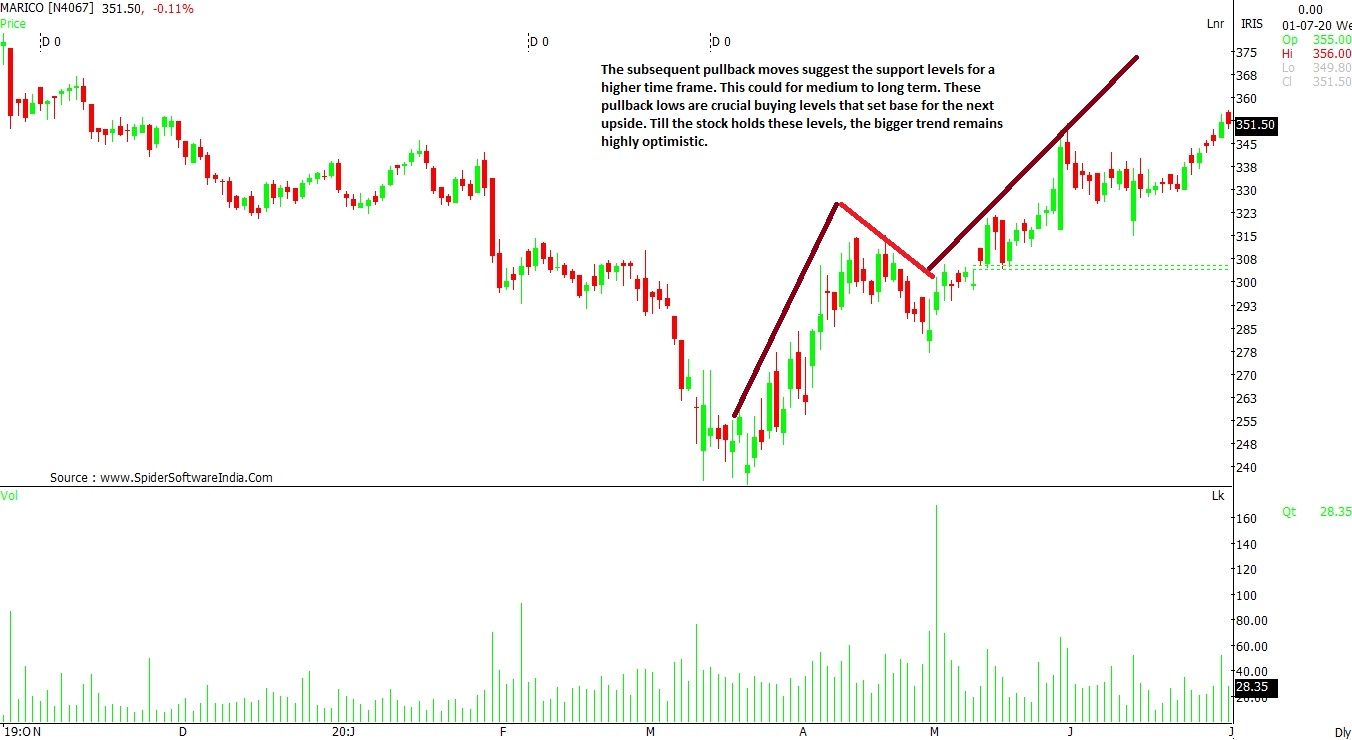
A pullback clearly suggests that the continuation trend is intact and the price should witness buying momentum at higher levels. Within a bigger trend, one can identify several opportunities in terms of chart patterns or candlestick breakout for added profits. Pullback lows are crucial buying levels that set the base for the next upside. Till the stock holds these levels, the bigger trend remains highly optimistic. (CLICK HERE TO VIEW CHART)

How to identify and trade a pullback rally?

A pullback will show a peculiar chart structure with volumes staying sideways. These structures may show consolidation, taking support around Fibonacci retracement, or swing trades that show Doji or Hammer patterns. Till such formations don’t get established, one should blindly look at accumulating the stock.

A biased interpretation of a pullback may result in losses and fear of capitulation. The correction may turn into a negative reversal if crucial supports are breached with aggressive volume.

Sometimes, the pullback rally gets recognized when some unexpected positive fundamental development adds further momentum to an already established. In such cases, it is advisable to wait for a breakout on consolidation or candlestick pattern to verify the continuation trend. Still, if the structure gets violated, then it is better to exit the stock. (CLICK HERE TO VIEW CHART)

Technical indicators and pullback rallies

Occasionally, technical indicators assist in identifying a pullback. The most significant is the price on the chart. One may see Relative Strength Index (RSI) falling from overbought condition but the price may not show much correction. Similarly, Moving Average Convergence Divergence (MACD) may turn into a negative crossover; however, the price may show sideways movement.  

Herein, the significance should be given to the price movement and moving averages. This could be a 50-day moving average (DMA), 100-DMA, 200-DMA or even lesser DMA. On the pullback, these averages will not show much weakness or turn downward; they will gradually continue their current trend and hold the price momentum.

One subscription. Two world-class reads.

Already subscribed? Log in

Subscribe to read the full story →
*Subscribe to Business Standard digital and get complimentary access to The New York Times

Smart Quarterly

₹900

3 Months

₹300/Month

SAVE 25%

Smart Essential

₹2,700

1 Year

₹225/Month

SAVE 46%
*Complimentary New York Times access for the 2nd year will be given after 12 months

Super Saver

₹3,900

2 Years

₹162/Month

Subscribe

Renews automatically, cancel anytime

Here’s what’s included in our digital subscription plans

Exclusive premium stories online

  • Over 30 premium stories daily, handpicked by our editors

Complimentary Access to The New York Times

  • News, Games, Cooking, Audio, Wirecutter & The Athletic

Business Standard Epaper

  • Digital replica of our daily newspaper — with options to read, save, and share

Curated Newsletters

  • Insights on markets, finance, politics, tech, and more delivered to your inbox

Market Analysis & Investment Insights

  • In-depth market analysis & insights with access to The Smart Investor

Archives

  • Repository of articles and publications dating back to 1997

Ad-free Reading

  • Uninterrupted reading experience with no advertisements

Seamless Access Across All Devices

  • Access Business Standard across devices — mobile, tablet, or PC, via web or app

Topics :Trading strategiesrules-based trading systemTrading lawTrading tipstechnical charts

Next Story