The mere single-digit year-on-year increase in volumes in Q3 also meant that after meeting obligations for supplies under the FSA, not much was left for e-auction sales. The sales mix suffered with 37 per cent year-on-year decline in e-auction sales, which are more profitable. With concerns over volumes and given the overhang on account of government’s stake sale plan continuing, it is not surprising that the Street’s reaction was muted even as Coal India posted better-than-expected Q3 numbers on Tuesday.
Pricing gains
The Street-beating performance for Q3 was driven by higher per tonne prices of notified (up 9 per cent year-on-year, as per analysts’ estimates) and FSA coal (up 13 per cent year-on-year to Rs 1,334). E-auction realisations per tonne, too, were higher by 43 per cent year-on-year and 10 per cent sequentially at Rs 2,847. As blended realisations pushed up revenues, profitability got a further boost by inclusion of evacuation facility charge of Rs 770 crore as well as from the company’s measures to control costs.
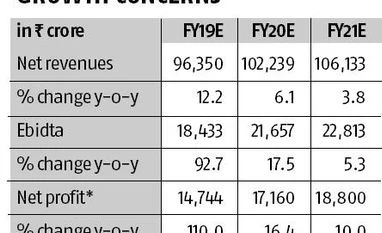
Thus, revenues grew 13 per cent year-on-year, while operating profit at Rs 5,127.4 crore came ahead of Rs 5,015 crore pegged by Bloomberg consensus estimates. Consequently, net profit at Rs 4,566 crore was also ahead of analysts’ estimates of Rs 3,845 crore.
Volume woes
While domestic demand is likely to remain buoyant, the ability of Coal India to improve volumes will be looked at eagerly by investors. Demand from the power sector is likely to remain high because of general elections and approaching summer season, say analysts. However, production volume growth and removal of evacuation bottlenecks will be crucial for the company to ensure higher supplies under FSA and also uptick in e-auction volumes. The recent production and sales data till January are not encouraging. Coal India’s shipments fell 2.3 per cent year-on-year in January 2019 even as production was up 0.7 per cent year-on-year as its large subsidiaries Mahanadi Coalfields (MCL) and South Eastern Coalfields (SECL) reported a 10.1 per cent and 9.4 per cent year-on-year decline in output, respectively. Analysts at Edelweiss Securities say that if the issues at SECL and MCL are not sorted, Coal India’s shipment growth could end at below 5 per cent in FY19.
Analysts at Prabhudas Lilladher, after the results, are already factoring in just 4.3 per cent, five per cent and 5.5 per cent growth in volumes for FY19, FY20 and FY21, respectively, as they feel structural issues related to land acquisition, logistics and statutory clearances may result in volumes growth remaining dismal. The weak outlook on volumes and a deteriorating balance sheet (resulting in dividend cuts) are reasons for the analysts maintaining the ‘Hold’ rating, similar to those by Edelweiss.
Moreover, there are some concerns on sustenance of e-auction realisations, too, looking at the declining international coal prices that can make imported coal attractive for domestic users. This could reduce the premium of e-auction price over FSA prices.
Coal India has seen its stock price decline by more than 25 per cent from August highs of Rs 300. However, even as the price-earnings ratio estimates at 8x FY20 appear reasonable, there are overhangs for the stock. Apart from concerns on volume growth, the government’s stake sale plans, too, have impacted investor sentiment.
The government, which had sold a threeper cent stake through an offer for sale in November last year, had also indicated an option to offload a further six per cent on over subscription which did not materialise. Thus, analysts feel this stake sale overhang will continue.
Meanwhile, Coal India has approved a buy back of 44.7 million shares (0.72 per cent of paid-up equity share capital) at a price of Rs 235 per share, which equates to a yield of 0.75 per cent. While this could provide some cushion to the stock, the outgo of cash could lead to further decline in other income, thereby weighing on the net profit.
One subscription. Two world-class reads.
Already subscribed? Log in
Subscribe to read the full story →
Smart Quarterly
₹900
3 Months
₹300/Month
Smart Essential
₹2,700
1 Year
₹225/Month
Super Saver
₹3,900
2 Years
₹162/Month
Renews automatically, cancel anytime
Here’s what’s included in our digital subscription plans
Exclusive premium stories online
Over 30 premium stories daily, handpicked by our editors


Complimentary Access to The New York Times
News, Games, Cooking, Audio, Wirecutter & The Athletic
Business Standard Epaper
Digital replica of our daily newspaper — with options to read, save, and share


Curated Newsletters
Insights on markets, finance, politics, tech, and more delivered to your inbox
Market Analysis & Investment Insights
In-depth market analysis & insights with access to The Smart Investor


Archives
Repository of articles and publications dating back to 1997
Ad-free Reading
Uninterrupted reading experience with no advertisements


Seamless Access Across All Devices
Access Business Standard across devices — mobile, tablet, or PC, via web or app
)