Diamond has young patrons too! Millennials and Gen Z biggest consumers

A DeBeers report claims global diamond production may decline in 2018 on mine closure, favourable demand will keep prices elevated
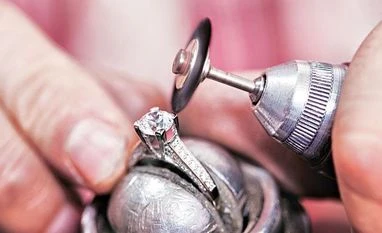
Craftsman work at a diamond processing unit
Dilip Kumar Jha
Last Updated : Sep 13 2018 | 4:00 PM IST
Global diamond output is likely to decline in calendar year 2018 due to suspension of excavation in mines by leading producers. De Beers Group’s latest Diamond Insight Report, released on Thursday, said that Alrosa-owned Mir mine suspended operations this year. 

"However, businesses in this sector will need to continue adapting to the evolving landscape,” said the report. De Beers, however, hoped that purchases made by Millennials and Gen Z generations accounted for two-thirds of global diamond jewellery sales in 2017, as demand in the segment reached a new record high of $82 billion. Millennials are consumers between 21 and 39 years, representing 29 per cent of the world’s population and are currently the largest group of diamond consumers. 

They accounted for almost 60 per cent of diamond jewellery demand in the US in 2017 and nearly 80 per cent in China. Gen Z, those currently aged up to 20, is an even larger consumer generation - representing 35 per cent of the world’s population and will come of age as diamond consumers over the coming decades.

Also, Rio Tinto has guided fall in production at its operations resulting into a decline in estimated rough diamond output in 2018. “Looking further ahead, production is expected to continue falling as new projects and expansions fail to replace lost output from closed mines. By 2028, several large mines will reach the end of their life, while only a few new projects are in the pipeline,” said the report. 

Global diamond production posted a 14 per cent increase at 164 million carats in 2017 from 144 million carats in the previous year. Total rough diamond production is estimated at $17.5 billion in 2017, a 15 per cent increase on 2016. De Beers Group accounted for the largest increase in production volume (6.1 million carats), followed by Rio Tinto (3.7 million carats) and Alrosa ( 2.3 million carats). Russia retained its position as the largest producer country in carat and value terms, the report said Meanwhile, sales of rough diamonds to cutting centres in the first half of 2018 were higher than the same period in 2017. 

Russia’s Alrosa de-stocked seven million carats in the first half to report an eight per cent increase in rough diamond revenues. While De Beers Group’s sales were lower in volume terms, sales values to cutting centres were maintained by higher prices and an improved mix. Rough sales to cutting centres, however, was reported at $16.6 billion in 2017, a  2 per cent increase from the previous calendar year. De Beers Group remained the largest supplier, but with a reduced share of 34 per cent (from 37 per cent in 2016). 

Alrosa’s share also decreased in 2017 to 25 per cent of total sales (from 27 per cent in 2016). 

In India, trading conditions continued to stabilise in 2017 after the short term disruption due to demonetisation. Reflecting the higher level of rough diamond production in 2017, India’s annual gross rough diamond import volumes increased to 195 million carats. Interestingly, the effects of demonetisation had largely diffused by the end of Q1 of 2017, leaving manufacturing and stock conditions stable. 

Also, initial concerns over the three per cent Goods and Services Tax (GST) regime on polished diamonds introduced in mid-2017 dissipated when the GST Council reduced the rate on diamonds and precious stones to 0.25 per cent in early 2018. “After a positive Q4FY2017 selling season, the midstream continued experiencing strong manufacturing demand at the start of 2018.

De Beers hoped that the blockchain technology under development would help improve overall diamond and jewellery sales in the years to come. Meanwhile, diamond prices may remain elevated in the current year on lower production estimates and growing consumer demand on a recovery in the global economy.

One subscription. Two world-class reads.

Already subscribed? Log in

Subscribe to read the full story →
*Subscribe to Business Standard digital and get complimentary access to The New York Times

Smart Quarterly

₹900

3 Months

₹300/Month

SAVE 25%

Smart Essential

₹2,700

1 Year

₹225/Month

SAVE 46%
*Complimentary New York Times access for the 2nd year will be given after 12 months

Super Saver

₹3,900

2 Years

₹162/Month

Subscribe

Renews automatically, cancel anytime

Here’s what’s included in our digital subscription plans

Exclusive premium stories online

  • Over 30 premium stories daily, handpicked by our editors

Complimentary Access to The New York Times

  • News, Games, Cooking, Audio, Wirecutter & The Athletic

Business Standard Epaper

  • Digital replica of our daily newspaper — with options to read, save, and share

Curated Newsletters

  • Insights on markets, finance, politics, tech, and more delivered to your inbox

Market Analysis & Investment Insights

  • In-depth market analysis & insights with access to The Smart Investor

Archives

  • Repository of articles and publications dating back to 1997

Ad-free Reading

  • Uninterrupted reading experience with no advertisements

Seamless Access Across All Devices

  • Access Business Standard across devices — mobile, tablet, or PC, via web or app

Next Story



