Foreign institutional investors (FIIs) shouldn’t need to register with the Securities and Exchange Board of India (Sebi) when looking to invest in the country, recommends a committee under the chairmanship of former Cabinet Secretary K M Chandrasekhar.
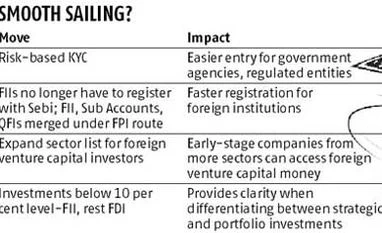
The panel has recommended doing away with prior direct registration of FIIs and Sub Accounts with Sebi, according to a statement on the regulator’s website. The committee has also recommended merging FIIs, Sub Accounts and Qualified Foreign Investors (QFI) into a new investor class to be called the Foreign Portfolio Investor (FPI).
“FPIs would be able to register themselves with and transact through Designated Depository Participants (DDPs). The qualification of DDPs would be as prescribed by Sebi,” said the statement.
Suresh V Swamy, executive director, tax & regulatory services, at PricewaterhouseCoopers, said the move would ease entry for foreign investors.
"It will (then) be much faster to get certification and there is likely to be significant reduction in the time required for a registration. Additionally, it will also save costs in the form of registration and renewal fees which were paid to Sebi," he said.
According to those involved in the process, the time required for FII registration is supposed to be seven days, and three days for sub-accounts. However, the process can take up to six to eight months in some cases, with time spent on documentation and follow-up queries. This is likely to reduce with registration through DDPs, a role likely to be played by custodians, according to those handling such matters.
<B>Other suggestions</B><BR>
The committee has also recommended that FPIs considered to be high risk entities not be allowed to issue Participatory Notes (P-Notes). It has also suggested a risk-based approach to the Know Your Client (KYC) procedures, dividing foreign investors into three categories in increasing order of perceived risk.
The first category includes government and government-related entities such as foreign central banks, and sovereign wealth funds. The second category would cover regulated entities such as banks and asset management companies already registered with Sebi. The third category would comprise any entities which do not come in the first two.
The committee has recommended doing away with the requirement of personal identification documents such as copy of passport, photograph, etc, of the designated officials of FPIs belonging to categories I and II. Those in category III will not be allowed to issue P-Notes.
Sandeep Parekh, founder and managing partner, Finsec Law Advisors, agreed with the different KYC procedures for different classes of investors. “Clearly, you need to have a more stringent KYC process for high-risk investors, while it can be simpler for sovereign wealth funds that are government-backed,” he said.
The committee has also recommended easing the norms for Foreign Venture Capital Investors (FVCIs). “The committee felt the present list of nine sectors should be considerably expanded. Alternately, a negative list may be announced by (the government), so that the rest of the sectors are opened for VCF activity,” went the statement.
Some suggest there is great scope for expanding the current list. “All sectors should be opened for FVCI. Why choose winners? Only certain sectors such as liquor, gambling and tobacco can be prohibited,” said Parekh.
Additionally, the committee has recommended a 10 per cent rule to define portfolio investments. Any investment beyond the threshold of 10 per cent in a company’s equity shall be considered foreign direct investment. It has suggested the categories of non-resident Indians and FVCI should continue.
The committee included representatives from the government and the Reserve Bank of India, beside various market participants.
In October 2012, the Sebi board had decided to rationalise various routes meant for portfolio investment in the country. Following which, the Chandrasekhar panel was set up by Sebi in December 2012. The panel, termed 'Committee on rationalisation of investment routes and monitoring of foreign portfolio investments', was asked to suggest steps for implementation of the Working Group on Foreign Investment in India (WGFI) recommendations. The WGFII, headed by U K Sinha, who was the UTI Mutual Fund chief at the time, had in 2010 suggested merging of all foreign investment routes.

 "FIIs may no longer have to register with Sebi")


 Connect with us on WhatsApp