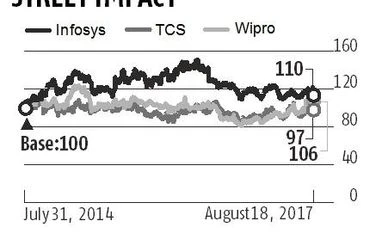
At a time when investors were expecting Infosys to spell out the detailed terms of its proposed buyback programme on Saturday, Vishal Sikka resigned as the managing director and chief executive of the company. Earlier in 2017, Infosys had unveiled plans to reward its shareholders by way of a buyback and dividend payout totalling Rs 13,000 crore.
Sikka’s resignation sent the stock plummeting – down over 13 per cent in intra-day deals on the Bombay Stock Exchange (BSE) to Rs 884 levels. It, however, settled 9.6 per cent lower at Rs 923. By comparison, the S&P BSE Sensex slipped nearly 0.9 per cent, or 271 points to 31,524 levels and the S&P BSE IT Index lost 3.5 per cent to 10,082 levels.
Markets, analysts say were taken completely by surprise by the timing of the development that comes a day ahead of Board meet to consider the proposed buyback programme. The bigger dilemma now, they say, is getting a replacement as there are not many choices internally (given several key personnel exits in last three years) and is equally a challenge to find an external candidate given the way things have been.
“I am not surprised by the move given the pressure he has been going through, but I am shocked at the timing of his resignation. The development comes a day ahead of the Board meet to spell out the proposed buyback terms and all the shareholders were expecting some good news from the company management. Investors should tender their shares if the buyback price is above Rs 1,000 per share,” says G Chokkalingam, founder and managing director of Equinomics Research & Advisory.
However, Ambareesh Baliga, an independent market analyst is not stumped by the resignation and feels the timing of the resignation a day ahead of the buyback is intended to cushion any major negatives that may arise from the development.
“Whatever said and done, we have the buyback happening now. I think the buyback was announced to cushion the development. Sikka’s exit is not a development that has happened overnight. It must have been planned days in advance, and because of this, Infosys announced the buyback in a hurry. I think investors should tender their shares in the proposed buyback,” Baliga says.
In its July 2017 report, analysts at Nomura had questioned the delay in execution of Infosys’ buyback proposal and suggested three possible reasons – approval from multiple regulators, FII holding and procedural differences – that could possibly have led to this. CLICK HERE FOR THE STORY
“We believe this is severe dent in brand reputation, client conversation, investor confidence, employee morale, business transformation which would affect its financial performance in the short-to-medium term. The stock may command lower valuation given the absence of positive triggers and incremental uncertainty in coming period,” said Rahul Jain and Ruchi Burde of Emkay Global in a report.
Sandip Agarwal, an analyst tracking the company with Edelweiss Research believes that the stock can dip to Rs 800 levels going ahead given Sikka’s resignation.
“This is a major negative news. One must realise that Vishal Sikka has quit and has not been elevated to a new post / role. The resignation letter from Sikka is very negative. I think the stock can dip sharply from here on, possibly to Rs 800 levels. Investors must utilise the buyback opportunity to exit the counter,” he says.
A K Prabhakar, head of research at IDBI Capital expects Infosys to announce share buyback of at least Rs 9,750 crore of the stated payout of Rs 13,000 crore. He expects the buyback price to be between Rs 1,100 to Rs 1,150. His revised target price for the stock is Rs 887, nearly 4 per cent lower than Friday’s close.