MP farmers shift from soybean to urad for better prospects, productivity

By Sept this year, Urad bean recorded its highest-ever sown area nationwide at 4.21 mn hectares
infographic
Abhishek Waghmare Mumbai
Last Updated : Sep 13 2017 | 1:50 AM IST
The area sown under soyabean in Madhya Pradesh, the leader in soyabean production has fallen from the five-year average of 5.8 million hectares to five million hectares in the kharif (summer) season of 2017.

At the same time, the area under urad bean (black gram) has risen to 1.8 million hectares, as against the average of 850,000 hectares in the state.

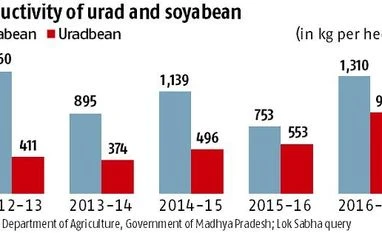
The area under urad bean has been the highest nationwide also, at 4.21 million hectares (as of September 6). It clocked record productivity in Madhya Pradesh in the 2016 cropping season, when it doubled to 906 kg per hectare (the national average being 645 kg a hectare). The productivity of soyabean was poor in 2013 and 2015 and fell below 900 kg a hectare. It was above 1,300 in 2012 and even in 2016.

“In some parts of Madhya Pradesh and Maharashtra, where there is light soil, soyabean has been damaged due to moisture stress, which may affect the overall productivity adversely in these areas,” the Kharif Season Survey Report of 2017, prepared by the Soyabean Processors Association of India, says.

The data show, and experts cite, three key reasons for this preference for urad this year.

Urad can do with less water than soyabean, and is less susceptible to pest and insect attacks.The second factor has been the deficient monsoon. “Due to a weak initial monsoon, the natural slot for sowing soyabean or arhar (pigeon pea) was missed, leaving urad the only viable option for the dry regions in Madhya Pradesh,” Sanjeev Gupta, project coordinator at the Indian Institute of Pulses Research (IIPR), Kanpur, told Business Standard. 

The third factor, and the one with the most far-reaching implications is the price fetched by the crop. While soyabean prices have stagnated in APMC (agriculture produce marketing committee) mandis, prices at non-APMC mandis and the government’s minimum support price were a strong incentive for farmers. 

But in the past one year prices of both soyabean and urad fell but soyabean remained in a narrow range and the higher productivity of urad, which means low cost of production, seems to have saved the day for farmers who shifted from soya bean.

Urad price shows hope, soyabean price stagnates

“Easy seed availability and the combination of sound MSP (minimum support price) policy, increased productivity and government procurement gave urad an edge over soya bean in 2017,” AK Tiwari, director at the Directorate of Pulses Development, Bhopal, told Business Standard.

Urad sowing, production, and productivity were at their peak in 2016, especially in Madhya Pradesh, but despite this, urad beans fetched a price higher than their MSP (Rs 5,000 a quintal): An average of Rs 6,011 a quintal in MP in October 2016. The national average was Rs 8,478 per quintal. However, prices of urad fell after last October’s spike.

This price signal improved the sowing of urad in Madhya Pradesh by 50 per cent over the previous year, and 200 per cent over the five-year average. Will the record urad production have the same effect on its wholesale price? Experts and the data point to different directions. “The price of urad bean, owing to the crop’s concentrated demand in south India, would probably not drop in a big way even after increased supply,” Gupta said.

Tiwari added: “The consumption pattern of urad is distinct from that of arhar, which makes it less susceptible to rapid price changes.” 

At the same time, the data from representative mandis show that in the 2015 supply glut, all the three major kharif pulses — arhar, urad, and moong — were equally affected.

The Union government has taken steps to reduce price volatility by capping the imports of urad and moong to 300,000 tonnes, against the average of 600,000 tonnes in previous years (Directorate General of Foreign Trade notification dated August 21, 2017).

The Madhya Pradesh government has approved a new scheme to pay the remainder — MSP minus mandi price — directly to farmers if the mandi price falls below the MSP. This scheme is yet to be notified.


One subscription. Two world-class reads.

Already subscribed? Log in

Subscribe to read the full story →
*Subscribe to Business Standard digital and get complimentary access to The New York Times

Smart Quarterly

₹900

3 Months

₹300/Month

SAVE 25%

Smart Essential

₹2,700

1 Year

₹225/Month

SAVE 46%
*Complimentary New York Times access for the 2nd year will be given after 12 months

Super Saver

₹3,900

2 Years

₹162/Month

Subscribe

Renews automatically, cancel anytime

Here’s what’s included in our digital subscription plans

Exclusive premium stories online

  • Over 30 premium stories daily, handpicked by our editors

Complimentary Access to The New York Times

  • News, Games, Cooking, Audio, Wirecutter & The Athletic

Business Standard Epaper

  • Digital replica of our daily newspaper — with options to read, save, and share

Curated Newsletters

  • Insights on markets, finance, politics, tech, and more delivered to your inbox

Market Analysis & Investment Insights

  • In-depth market analysis & insights with access to The Smart Investor

Archives

  • Repository of articles and publications dating back to 1997

Ad-free Reading

  • Uninterrupted reading experience with no advertisements

Seamless Access Across All Devices

  • Access Business Standard across devices — mobile, tablet, or PC, via web or app

Next Story



