Planters demand higher subsidy for orthodox tea
Production cost for high grade CTC is Rs 185 a kilo on an average while cost of production for lowest quality of orthodox is around Rs 210 a kilo
Avishek Rakshit Kolkata While Indian tea producers are keen to boost the production of orthodox tea, which could help the stressed tea sector to better its global price realisation, the producers are asking for a higher subsidy on production of this tea variant from the Tea Board of India.
According to the north Indian tea sector, represented by the Indian Tea Association (ITA), the cost of orthodox tea production is 13 per cent higher than the production cost of CTC (crush, tear, curl) tea.
Orthodox tea, in comparison with the CTC variant, is labour-intensive as it involves selective plucking of the leaves. ITA says labour costs, which comprise 60 per cent the total costs, have gone up significantly over the past 10 years while the total cost has escalated by 10 per cent per annum.
The production cost for high-grade CTC is Rs 185 a kg on an average while the cost of production for the lowest quality of orthodox is around Rs 210 a kg.
“Increasing the subsidy would not only help the planters mitigate the rising costs but it will also boost CTC players to switch over to orthodox tea,” ITA’s chairman Azam Monem told Business Standard. Five years ago, while the conversion rate accrued by the producers to switch over from CTC production to orthodox production stood at Rs 14-15 a kg, the same rate has gone up between Rs 20 and Rs 30 a kg.
Monem said in case the Tea Board, which operates under the aegis of the Union commerce ministry, consents to increase the subsidy, the annual domestic production will top 100 million kg, up from the existing 85 million kg.
While ITA has placed the proposal to increase the subsidy at both the Tea Board and the Union commerce ministry’s table, the Tea Board has appointed the Indian Institute of Planning and Management to conduct a study over the industry’s demand.
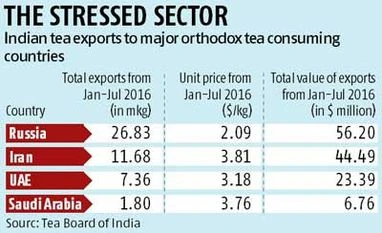
The Tea Board has also been encouraging production of orthodox leaves as this variety fetches a premium in the global market, especially in Russia and West Asia, which are major markets for the entire tea sector.
Furthermore, to better market the orthodox tea which results in better prices, the Tea Board has introduced the geographical indication tag for the gardens in Assam and Niligiris.
According to industry sources, of the total estimated 80 million kg production of orthodox tea in the country, five per cent is consumed in India while the rest is exported.
C S Bedi, managing director of Rossell Tea, a major orthodox tea player, said while CTC tea fetches $2.5 a kg in the global market, the orthodox variant is priced at $3.5.
Going by this price index, last year, 74 million kg of orthodox tea exports would have fetched $259 million to the total forex inflow of $678.78 million from global tea sales.

 "Planters demand higher subsidy for orthodox tea")


 Connect with us on WhatsApp