Associate Sponsors

Co-sponsor

Rs 1-trn club shrinks in 2018: Nestle to BPCL, here're winners and losers

Markets this year have been choppy with the Sensex gaining as much as 14% at one point to lifetime highs and then declining close to 15%.
Chart
Sundar Sethuraman Mumbai
Last Updated : Dec 09 2018 | 9:05 PM IST
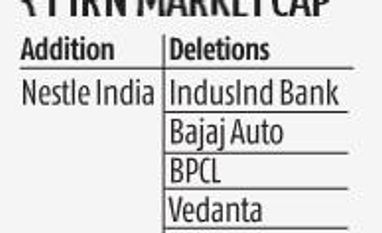
Companies with more than Rs 1 trillion market capitalisation have gone down by five in 2018 despite the benchmark Sensex gaining 5 per cent. Automobile company Tata Motors, metals and mining major Vedanta, oil marketing firm Bharat Petroleum Corporation (BPCL), private sector IndusInd Bank, and two-wheeler major Bajaj Auto have witnessed their market cap slip below the Rs 1-trillion mark this year. Currently, there are 27 companies in the club, down from 31 at the end of 2017. Consumer goods company Nestlé is fresh in the club.

Last calendar year, the markets saw a secular upward move with the benchmark Sensex gaining 28 per cent and the NSE Midcap 100 index rallying 47 per cent. Markets this year have been choppy with the Sensex gaining as much as 14 per cent at one point to lifetime highs and then declining close to 15 per cent. 

“Except for 10 or 15 companies, everybody else has seen an erosion in its market cap this year. Last year, the rally was broad-based. This year, it has been extremely skewed in favour of select stocks,” said G Chokkalingam, founder, Equinomics Research and Advisory.

Among the 31 companies that were in the Rs 1-trillion club during the start of the year, 16 have seen an erosion in their market cap, while the others have witnessed an increase.

In absolute terms, Tata Consultancy Services (TCS), Reliance Industries (RIL) and Hindustan Unilever (HUL) saw a big increase in their market cap. TCS has added Rs 2.32 trillion in its market cap to Rs 7.5 trillion; RIL has added Rs 1.35 trillion to Rs 7.2 trillion; and HUL has added nearly Rs 1 trillion to Rs 3.94 trillion.

The worst erosion in absolute terms was for Bharti Airtel. It’s market value eroded by Rs 900 billion to Rs 1.21 trillion. Tata Motors saw its market cap value go down by Rs 780 billion, or 62 per cent, to Rs 469 billion, and Maruti Suzuki witnessed its market value decline by Rs 730 billion to Rs 2.2 trillion.

Market participants said a combination of global and local factors have led to a lot of volatility in the market. Locally, the reintroduction of long-term capital gains, goods and services tax (GST), and the IL&FS default have weighed on investors' sentiment. On the global front, the rising US dollar and bond yields led to risk-aversion among overseas investors, who pulled out close to $5 billion from domestic stocks in 2018. Besides, rising tensions between the US and China, two of the world’s largest economies, have also weighed on the companies linked to global trade.


One subscription. Two world-class reads.

Already subscribed? Log in

Subscribe to read the full story →
*Subscribe to Business Standard digital and get complimentary access to The New York Times

Smart Quarterly

₹900

3 Months

₹300/Month

SAVE 25%

Smart Essential

₹2,700

1 Year

₹225/Month

SAVE 46%
*Complimentary New York Times access for the 2nd year will be given after 12 months

Super Saver

₹3,900

2 Years

₹162/Month

Subscribe

Renews automatically, cancel anytime

Here’s what’s included in our digital subscription plans

Exclusive premium stories online

  • Over 30 premium stories daily, handpicked by our editors

Complimentary Access to The New York Times

  • News, Games, Cooking, Audio, Wirecutter & The Athletic

Business Standard Epaper

  • Digital replica of our daily newspaper — with options to read, save, and share

Curated Newsletters

  • Insights on markets, finance, politics, tech, and more delivered to your inbox

Market Analysis & Investment Insights

  • In-depth market analysis & insights with access to The Smart Investor

Archives

  • Repository of articles and publications dating back to 1997

Ad-free Reading

  • Uninterrupted reading experience with no advertisements

Seamless Access Across All Devices

  • Access Business Standard across devices — mobile, tablet, or PC, via web or app

Next Story



