Sensex down 800 pts as global sell-off accelerates
This was the biggest fall in the markets in nearly six months
BS Reporter Mumbai Investors lost more than Rs 3 lakh crore as the stock markets fell by more than 800 points on Thursday, after foreign investors intensified their selling on a weak global economic outlook and concerns over the health of Indian banks.
The BSE realty, oil & gas indices and the BSE bankex were the top sectoral losers. The S&P bank index went down 3.81 per cent, from 16,519.15 on Wednesday to 15,889.92 on Thursday.
This was the biggest fall in the markets in nearly six months.
Panic-stricken investors exited riskier asset classes such as equities and oil and bought into safe-haven gold as concerns remained over the ability of central banks to infuse momentum in the economy. Uncertainty over the government's economic agenda and disappointing corporate earnings added to the panic.
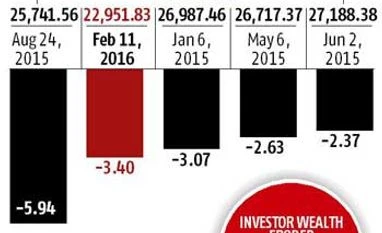
The benchmark Sensex on Thursday dropped 807.1 points, or 3.4 per cent, to end at 22,951, while the Nifty plunged 239.4 points, or 3.3 per cent, to 6,976.4. This was the biggest single-day drop in the Sensex since August 24, 2015, when the index had crashed nearly six per cent on a surprise devaluation of the Chinese yuan.
This week alone, the 30-share Sensex lost 6.7 per cent and reached its lowest level since May 9, 2014. The index is now down 23 per cent from its all-time high of near-30,000 in January 2015. A fall of over 20 per cent is considered the start of a bear market. On a year to date basis, the gauge is down over 12 per cent in rupee terms and around 15 per cent in dollar terms.
The rupee on Thursday ended at 68.3 against the dollar, compared to the previous day's close of 67.85. The sharp drop in the rupee was on the back of a sharp sell-off by overseas investors.
According to provisional figures, foreign institutional investors pulled out over Rs 1,100 crore from stocks on Thursday.
"Emerging-market (EM) funds are facing redemptions and India is still overweight among these funds. That is a negative. Valuations have become reasonable, but I don't think anybody has the confidence to buy because money is constantly flowing out of EM funds," said Sanjeev Prasad, co-head and senior executive director at Kotak Institutional Equities.
FIIs have taken out over $2 billion (over Rs 13,000 crore) from the domestic markets so far this year. The selling has been offset by purchases by domestic investors, especially mutual funds. However, the sharp fall in the market this year has raised concerns whether inflows into mutual funds will moderate further.
Market players say the fall in the market, coupled with the delay in earnings revival, is hurting investor sentiment. Nearly half of the companies that have announced their December quarter earnings have failed to meet expectations, say analysts.
"Corporate earnings downgrades could continue for a few more quarters, however, given the base effect and indications of economic recovery, the pace of these downgrades could be relatively lower," said Anand Radhakrishnan, chief investment officer, Franklin Equity. "The corporate profit cycle is close to all-time lows and hence valuations appear reasonable at the current stage."
The Sensex now trades at 14 times its one-year forward earnings, below its historic average, however, still above the lows seen during 2008.
With inputs from Bloomberg

 "Sensex down 800 pts as global sell-off accelerates")


 Connect with us on WhatsApp