The market soared in pre-Diwali trading. Strongly bullish global trends, excellent results by Reliance Industries and high liquidity translated into new highs. The Nifty hit 10,251 before seeing some profit-booking.
Although foreign portfolio investors (FPIs) remained net equity sellers, retail and domestic institutional buying picked up. The Nifty stayed comfortably above 10,200. Obviously, the new highs confirm the long-term trend remains bullish. This is a new zone so, target setting is hard. Depending on levels of optimism, any target between 10,400 and 10,650 could be hit. The bounce came from support at 9,675-9,700, which has held on the past two downtrends.
Trend following systems suggest staying long, with a trailing stop-loss at 10,125. The background signals are strongly bullish. The Advance Decline ratio is positive for the past five sessions. The VIX is in calm territory but it's seen an uptick that implies profit-booking. We saw some selling on Tuesday.
The 200-Day Moving Average is around 9,300, way below the current mark. Taking a longer-term view, the Nifty moved North in late December 2016 from 7,900 levels to a high of 10,251 in mid-October. It has bounced twice from 9,675. The break above 10,200 to a new high indicates strong momentum, while the market should stay above 9,675 on the next downtrend. In the short-term, profit-booking should find support at 10,100-10,150.
The Nifty Bank is much less bullish. Axis Bank had disappointing results and other financials have also seen selling. The Bank index had reacted down from an all time high at 25,200 in early August and it's having trouble staying above 24,700. More selling here could affect the Nifty, given the high weight of financials in the broad index.
However, two big trending sessions could push the "Bank" beyond 25,200. If there is selling, three sessions could take it below 24,000. A strangle of long October 26, 25,000c (33), long October 26, 24,000p (38) costs around 72. This is not zero-delta since the calls are closer to money with the index held at around 24,650. An alternative position is a bearspread as a hedge against a potential fall. A long October 26, 24,000p (38), short 23,500p (18) costs 20, and it could have a big payoff if the financial index crashes.
The Nifty's Put-Call Ratio (PCR) is bullish with both the October PCR (1.7) and the three-month PCR (1.6) comfortably above 1. In fact, this is in the danger zone since it's above 1.5 where the index often reacts and that could indicate a possible sell-off/correction. The October Nifty call chain has peak open interest (OI) at 10200c, and high OI until 11,000c. The October put chain has very high OI between 9,500p and 10,300p with a peak at 10,000.
The Nifty closed at 10,234 on Tuesday. The short-term trend could see some selling as noted above. A bullspread of long 10,300c (40), short 10,400c (15) costs 25 and pays a maximum 75. This is about 65 points from money. A bearspread of long 10,200p (47), short 10,100p (27) costs 20, pays a maximum of 80 and is 30 points from money.
These spreads are not zero-delta. But, they could be combined. The resulting position costs 45, with breakevens roughly at 10,155, 10,345. There are few sessions left but there's usually a fair amount of volatility around the Diwali period.
The major triggers will be corporate results. Expectations are low so the market sentiment would not be hit very hard by poor numbers and there may be upside surprises. Retail volume also tends to dip as people go on holiday. That could be critical since retail is very bullish and the FPIs are liable to keep selling.

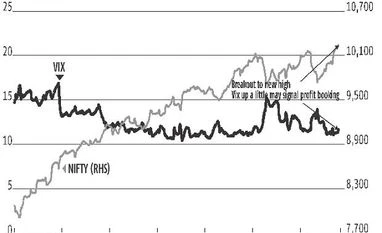 "Stay long on Nifty, with a stop at 10,125")












 Connect with us on WhatsApp