Deven Choksey, MD, K R Choksey, says: “After the mid-cap carnage last fortnight, now the fall has started in large-cap stocks. Foreign institutional investors are selling, and they sell what’s saleable in the market. Their exit is driven by the threat of rupee depreciating further. They are estimating Rs 74-76/$. And to protect their portfolios from currency loss (mark-to-market), they are taking out funds from Indian markets, along with other markets. Unfortunately, it started with currency fall and has now extended to stocks.”
The worst part about such corrections is that fundamentals of the blue-chip companies, where the fall has started, really don’t matter. Even good companies can take a severe knock because of the overall sentiment.
No quick end to pain: Rising oil prices have created worries about higher inflation and widening of the fiscal deficit. “The high price of oil is a big concern for the economy and markets. The steep fall in the exchange rate has also emerged as a major concern,” says G Chokkalingam, founder, Equinomics Research & Advisory.
Lack of liquidity in the hands of investors is also contributing to the current meltdown, according to Chokkalingam. Wealth erosion started with companies suffering from governance issues and balance sheet crisis. It then spread to non-performing assets-laden public sector banks, over-valued private lenders, and then to the leading indices.
On Friday, the markets were also expecting the Reserve Bank of India (RBI) to intervene to check the fall of the rupee by raising the benchmark rate, which it did not in its fourth bi-monthly monetary policy review of 2018-19. Many expect that the rupee may weaken further.
Stick to defensives: As there cannot be an early resolution to the issues affecting market sentiments, experts suggest that investors should hunt for quality large-cap stocks that didn’t participate in the rally. “Our preference remains with large-caps, given the premium of midcaps to large-caps in an environment of challenging macros, the potential slowdown in domestic equity flows, and a forthcoming busy political calendar,” states a report from Motilal Oswal.
The rupee’s fall has a positive impact on the earnings of export-oriented sectors. “We have 25 per cent weight towards information technology (IT) companies in our model portfolio,” says Kulkarni.
Defensive sectors tend to do well in uncertain times. Investors can, therefore, look at large pharma companies. Most fast moving consumer goods stocks are expensive, but some large companies are trading at a discount to market leaders. They could deliver better returns over the next two-three years.
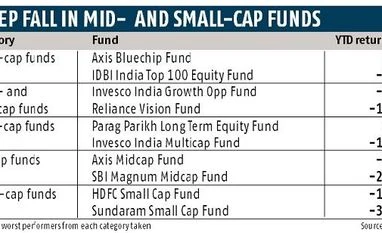
Investors should also consult their financial advisors to see if they are in products that are suited to their risk profile. “It is only when you go through a correction and see losses in your portfolio that you get a sense of your true risk appetite,” says Gupta. Inexperienced investors tend to chase the highest-yielding asset class, which in 2017 consisted of micro-cap, small-cap and mid-cap funds. “If an investor has ongoing SIPs that are focused largely on mid- and small-cap funds, he should rebalance and increase allocation to large-cap funds,” says Nikhil Banerjee, co-founder, Mintwalk. At least 60-70 per cent of the equity portfolio should be in large-cap funds. And this change in allocation should be accomplished by investing more in large-cap funds rather than selling mid- and small-cap funds.
Diversify into debt funds: Experts say that first-time investors, who were earlier investing in fixed deposits should opt for hybrid funds, like equity savings funds, aggressive hybrid (balanced) funds or balanced advantage funds. Currently, if they have exposure only to equity funds, they could diversify into debt funds to make their portfolios more stable. “Since interest rates are unlikely to soften in the near-term, invest in liquid funds and ultra-short term debt funds. Anything having an average maturity of more than one year will be exposed to duration risk,” says Banerjee. He adds that investors funds that take high credit risk to earn extra returns should also be avoided.
One subscription. Two world-class reads.
Already subscribed? Log in
Subscribe to read the full story →
Smart Quarterly
₹900
3 Months
₹300/Month
Smart Essential
₹2,700
1 Year
₹225/Month
Super Saver
₹3,900
2 Years
₹162/Month
Renews automatically, cancel anytime
Here’s what’s included in our digital subscription plans
Exclusive premium stories online
Over 30 premium stories daily, handpicked by our editors


Complimentary Access to The New York Times
News, Games, Cooking, Audio, Wirecutter & The Athletic
Business Standard Epaper
Digital replica of our daily newspaper — with options to read, save, and share


Curated Newsletters
Insights on markets, finance, politics, tech, and more delivered to your inbox
Market Analysis & Investment Insights
In-depth market analysis & insights with access to The Smart Investor


Archives
Repository of articles and publications dating back to 1997
Ad-free Reading
Uninterrupted reading experience with no advertisements


Seamless Access Across All Devices
Access Business Standard across devices — mobile, tablet, or PC, via web or app
)