The market is into another phase of range-trading. The FIIs have been consistent sellers since the taper started. Retail is bullish and domestic institutions are also bullish. This has prevented the major indices from falling much since the Reserve Bank of India (RBI) raised the policy rate.
The Nifty has tested support many times between 5,950-6,000 and it has lifted above the 6,000 level. However it appears unable to break through resistance above 6,150. As such it appears likely to continue trading between 5,950-6,150 until some news-based event leads to a shift in sentiment.
If the support at 5,950-5,975 breaks, the market could fall quite a distance. That is the zone where the 200-Day Moving Average (DMA) is located and a breach below the 200-DMA would indicate a worsening of the long-term trend. On the upside, there's resistance at 50-point intervals. Breadth indicators are positive but that's more due to retail sentiment rather than being institutional support.
Corporate results have been absorbed and more or less discounted. The global situation is not likely to change much in the immediate future. The vote on account in itself should not cause any tremors. But political instability or macro-economic data may. There is also the chance of the AAP triggering a crisis in the Delhi state government by provoking a withdrawal of support. And, of course, there is the shadow of general elections. So political instability is the main fear.
Technically speaking, the biggest danger is probably the Bank Nifty. The financial index is way below its own 200-DMA and it is range trading between 10,000 and 10,300. The futures is now at nominal backwardation to the spot index and that's a danger signal at this point of settlement. If the Bank Nifty breaks down below support at 9,850-9,900, it would take the entire market down with it. It is showing some signs of stabilising but despite that, a bearspread with long 10,000p (165) and short 9,500p (51) is quite tempting. The Bank Nifty is itself high-weight and high-beta and it could affect rate sensitives like NBFCs, real estate, automobiles, etc.
The rupee has held up well to the acceleration of the taper despite the FII sell off. There could be some pressure on the currency at end-of-month as importers will source dollar. If dollar gains, IT and to some extent, pharma will have to play the role of hedges. The CNXIT could be an outperformer on every dollar uptick. The Nifty's put-call ratio (PCR) continues to look healthy at between 1.25 and 1.3. This PCR could indicate that the market will hold onto support at 6,000 and keep testing 6,150-plus. The near-the-money strangle of long 6100c (74) and long 6,000p (70) has breakevens at 6,856 and 6,244.
Option traders should be prepared for a Nifty swing anywhere between 5,750 and 6,350 in the next five sessions if there is a breakout from the current trading range. Any move outside 5,900 or 6,200 will trigger a cascade of stop losses.
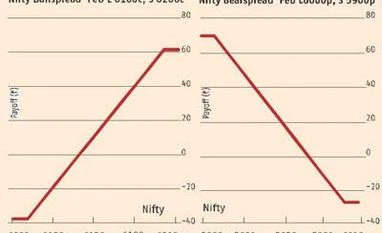
The February bullspread at long 6,100c (74) and short 6,200c (35) costs 38 and pays a maximum of 62. The bearspread of long 6,000p (70) and short 5,900p (42) costs 28 and pays a maximum 72. Obviously the bearspread has better risk: reward payoff, given that these spreads are more or less zero-delta with the Nifty held at 6,053. A wide strangle with long 6,200c and a long 5,900p offset with a short strangle of short 5,800p (24) and short 6,300c (14) costs 39 with breakevens at 5,861, 6,239. This is quite attractive, given chances of both sides being hit.

 "Weakness in Bank Nifty may take market down")


 Connect with us on WhatsApp