Whitefly attack highlights need for better Bt cotton
Crop loss due to this is estimated at 40-50%of the total crop or around 1.5 to 2 million bales
Komal Amit GeraRajesh Bhayani Chandigarh/Mumbai An attack of whitefly and diseases like leaf curve virus on the cotton crop in North India has taken an ugly shape. Yields have fallen sharply, with allegedly spurious pesticide supply worsening the situation, even sparking farmer suicides.
At a time when the cotton market in general has been down for over a year, it has brought to light the need for an improved variety of genetically modified (Bt) cotton. Farmers in Punjab and Haryana have launched an agitation, as half their cotton crop is estimated to have been lost, with intense spending on pesticides having aggravated the situation.
Whitefly is a plant-sucking pest. It has damaged most of the cotton crop in Punjab and to a large extent in Haryana (and in Rajasnthan's Ganganagar district). The crop loss due to this is estimated at 40-50 per cent of the total or 1.5 to two million bales (a bale is 170 kg). The Haryana and Punjab governments had set up a committee of experts to study the impact and find solutions. On Monday, it met and agreed there was a need to break the monoculture of Bt sowing.
The experts decided to recommend that farmers sow a combination of indigenous Narma, hybrid and Bt Cotton, as this can help curb the spread of pests. This can be done in a phased manner. It appears Punjab government officials also had a meeting with representatives of seed technology companies on better Bt varieties; the existing strain resists bollworm but is vulnerable to other pests.
The government of Punjab has announced a relief package of Rs 600 crore for those affected farmers but farmers say this would amount to about Rs 8,000 an acre, against their actual cost of Rs 15,000 to Rs 20,000 an acre. Multiple use of spurious pesticides, reportedly 10 times the normal use in many cases, has fulled the crisis. Early last month, a senior official from the agriculture ministry of Punjab was arrested on charges for procuring and supplying spurious pesticide.
Two women from farmer families reportedly committed suicide in the Bathinda district of Punjab last week. Farmers are planning to intensify their agitation; they say 25 farmers have committed suicide.
“My entire 20 acres has been damaged. There is no crop for harvesting. I will join the protesting farmers. I have no means to live otherwise,” said Jaswinder Singh of village Mehma Sajra in Bathinda.
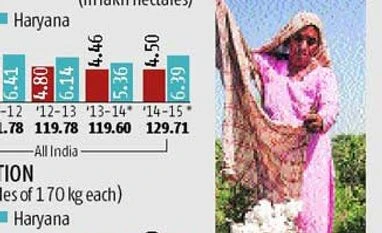
Punjab and Haryana together have been producing 4-4.5 million bales a year. However, compared to an 800 kg a hectare yield in Punjab during 2013-14, it fell to 528 kg last year, said an official from the Confederation of Indian Textile Industry. Similarly, the yield in Haryana fell from 761 kg a ha to 665 kg a ha.
Jagtar Singh Mehma, another farmer from Bathinda, says he hadn't seen this extent of damage in 35 years of farming. He is worried the pest is still around and could harm rabi crops, too. Scientists at the Central Institute for Cotton Research (CICR) confirm that whitefly can affect many other crops and some serious action from the states' agriculture department is needed.
Dilip Monga, head of CICR's regional station says erratic weather played a crucial role in growth of the whitefly. If the temperature had been lower in the winter, it would have kept the incidence down, as ground frost helps to break the whitefly's life cycle. CICR says it provided extension training to the state government machinery to fight the whitefly since July but ground execution is the responsibility of the latter.

 "Whitefly attack highlights need for better Bt cotton")


 Connect with us on WhatsApp