
ICC scraps boundary count rule that cost New Zealand World Cup 2019
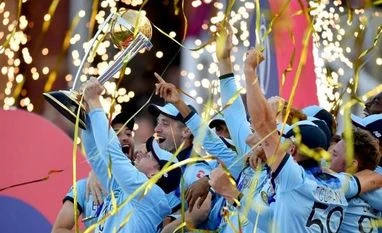
England scripted the history as they claimed their first-ever World Cup title in July this year, thanks to boundary count rule
 "ICC scraps boundary count rule that cost New Zealand World Cup 2019")
WebinarsNew
Deep DiveNew
Explore Business Standard
England scripted the history as they claimed their first-ever World Cup title in July this year, thanks to boundary count rule
International Cricket Council (ICC) on Monday scrapped the boundary count rule and in case of a super over tie there will be a repeated super over until one team has more runs than the other.
Following on from a recommendation from the ICC Cricket Committee, the Chief Executives' Committee agreed that the use of the super over as a way to decide results at ICC events will be retained. Both the Cricket Committee and CEC agreed it was an exciting and engaging conclusion to the game and will remain in place covering all games at both ODI and T20I World Cups.
England scripted the history as they claimed their first-ever World Cup title in July this year. The final will be remembered for ages as it did not have a winner after the 50-over and super over action, both of which were tied. In the end, England were announced as the winner as they had hit more boundaries, 26, as compared to New Zealand's 17 boundaries in the match.
New Zealand had set up 242 for England. As the hosts needed nine runs off three balls, all-rounder Ben Stokes hit the ball into the deep off Trent Boult and ran for a double. New Zealand's Martin Guptill threw the ball in an attempt to run out Stokes but the ball bounced off Stokes' bat and reached the boundary. As a result, England were awarded six runs - two for a double and four for an overthrow.
Taufel, who had umpired during the 2011 World Cup final, confirmed that the officiating umpires Kumar Dharmasena and Marais Erasmus made a mistake.
"There was a judgment error on the overthrow. The judgment error was the timing of when the fielder threw the ball. The act of the overthrow starts when the fielder releases the ball. That's the act. It becomes an overthrow from the instant of the throw," the Sydney Morning Herald quoted Taufel, as saying.
In group stages, if the super over is tied the match will be tied. In semifinals and finals, there is one change to the super over-regulation in keeping with the basic principle of scoring more runs than the opponent to win, the super over will be repeated until one team has more runs than the other.
The ICC Board also approved a USD 30.5 million funding allocation for Associate Members for 2020, a 12 per cent increase from 2019. The money, which will be distributed according to the Associate Member scorecard competition and grant model, will support all aspects of the development of the game in 92 countries focusing on participation and improving the competitiveness of international cricket.
Indra Nooyi has been unanimously reappointed as the ICC independent Director for a second two-year term from 2020-2022.
The Board approved the establishment of a Governance Working Group to consider the future governance structure of the ICC. The group will be chaired by Earl Eddings from Cricket Australia and will comprise Greg Barclay (New Zealand Cricket), Tony Brian (Cricket Scotland), Ehsan Mani (Pakistan Cricket Board), Chris Nenzani (Cricket South Africa) and Ricky Skerritt (Cricket West Indies).
First Published: Oct 15 2019 | 12:03 AM IST


 Connect with us on WhatsApp