
NASA's Kepler probe discovers over 1,200 new planets
Giving fresh hopes to astronomers to discover another Earth reverberating with life
 "NASA's Kepler probe discovers over 1,200 new planets")
WebinarsNew
Deep DiveNew
Explore Business Standard
Giving fresh hopes to astronomers to discover another Earth reverberating with life
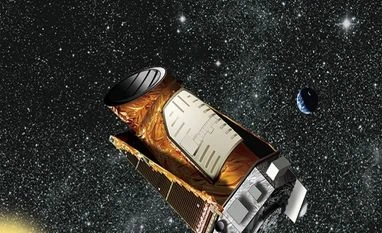
NASA's Kepler mission has verified 1,284 new planets - the single largest finding of planets to date - giving fresh hopes to astronomers to discover another Earth reverberating with life.
Scientists from Princeton University and NASA confirmed that 1,284 objects observed outside Earth's solar system are indeed planets.
"This announcement more than doubles the number of confirmed planets from Kepler so far to more than 2,300," said Ellen Stofan, chief scientist at the NASA headquarters in Washington.
"This gives us hope that somewhere out there, around a star much like ours, we can eventually discover another Earth," he added.
The discovery hinges on a technique developed at Princeton that allows scientists to efficiently analyse thousands of signals Kepler has identified to determine which are most likely to be caused by planets and which are caused by non-planetary objects such as stars.
This automated technique -- implemented in a publicly available custom software package called Vespa -- computes the chances that the signal is in fact caused by a planet.
The researchers used Vespa to compute the reliability values for over 7,000 signals identified in the latest Kepler catalogue, and verified the 1,284 planets with 99 per cent certainty.
They also independently verified more than 700 additional planet signals that had already been confirmed as planets by other methods.
In addition, the researchers identified 428 candidates as likely "false positives" or signals generated by something other than a planet.
Lead researcher Timothy Morton from Princeton developed Vespa because the vast amount of data Kepler has gathered since its 2009 launch has made the traditional method of confirming planets by direct ground-based follow-up observation untenable.
"Vespa is a culmination of a change in attitude about how we deal with these large-data surveys," Morton said in a paper appeared in the Astrophysical Journal.
Kepler, which ended data collection for its primary mission in 2013, operated by precisely measuring the brightness of many stars simultaneously.
The satellite looked for stars that exhibited subtle and regular dimming, which indicates that an orbiting planet is passing in front of, or transiting, that star.
First Published: May 11 2016 | 1:00 PM IST


 Connect with us on WhatsApp