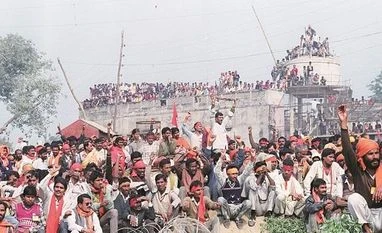
Special Central Bureau of Investigation (CBI) court judge S K Yadav has passed a remarkable judgment acquitting all the 32 people accused of hatching a criminal conspiracy to demolish the 400-year-old Babri Masjid in Ayodhya on December 6, 1992. The principal points in the acquittal of the accused — which included former Bharatiya Janata Party stalwarts L K Advani, Murli Manohar Joshi, Uma Bharti and then UP Chief Minister Kalyan Singh — was that there was no evidence of pre-planning and that several of them had tried to restrain the mobs. The criminal case has a tortuous history, taking 28 years to conclude following several extensions. In 2017, a two-judge Bench of the Supreme Court had restored conspiracy charges against the accused, on an appeal filed by the CBI against a discharge given to them by the Allahabad High Court. This suggests that the apex court justices had seen some merit in the case. The special CBI court, however, ruled that the authenticity of the video and audio clips that the CBI had produced could not be established and that those who climbed the domes to destroy them were “anti-social elements”. It is possible that these clips do not conclusively prove the specific fact of pre-meditation. But the court does not seem to have subjected to scrutiny the question of how over 300,000 such “anti-social elements”— otherwise described as kar sevaks by the Sangh Parivar — had gathered at Ayodhya in the days leading up to December 6.
It is also unclear why devotees who had turned up for a ritual puja and sacrifice should be equipped with pickaxes, ropes, shovels, iron rods and explosives that enabled them to destroy the thick walls of this medieval structure in a matter of hours and even have at hand bulldozers to flatten the rubble for a makeshift temple. It is hard to understand how mobilisation of this magnitude and equipping the mob in this way — both undisputed facts — cannot point to pre-meditation. There are also the arguments and evidence provided by the Liberhan Commission — itself an epic 17-year exercise — that point to the ideological framework established by the accused that furthered the case for the destruction of the mosque and the creation of a temple. As the enquiry report points out, the Rath Yatra was predicated on precisely this exercise, which other stalwarts had publicly endorsed in incendiary speeches, which formed the basis of CBI’s criminal conspiracy. Their presence at an event that was clearly spoiling for something more than a peaceful yagna surely demanded deeper probing.

 "Guiltless crime")












 Connect with us on WhatsApp